Blog Archives

Sophia’s Self-Determination (version 1)

SophiasSelfDetermination1ematted

One of the latest cultural rages is to have tattoos all over your body. I’ve noticed this trend increasingly over the last several years. Up in Nebraska, people are mostly conservative, so I didn’t see too many folk with tattoos all over their bodies when I lived there. I suppose more people had tattoos in the inner city of Omaha however. I bet this trend has increased there, too.

Here in Albuquerque, I see so many people with tattoos. Just workers in restaurants and super warehouse stores. I suppose people in the higher echelons of business and corruption just cover up their tattoos with long sleeve button-ups and ties. Is this ghetto? I’m rather proud of myself for not having a single tattoo on my body. It’s a symbol—or absence of a symbol—of my stubborn independence and to not give in to peer pressure. Yes, peer pressure continues on after high-school and college. It just upgrades to cars, lawns, bodies, wives, husbands, kids, and cell-phones. The fun of never having enough never stops.

I believe the fetish with having tattoos stems from the general aversive American attitude towards touching people, other than loved ones and relatives. I believe the ritual of getting a tattoo creates a very impressive—and painful—memory on one’s body. To me, it’s sort of a destructive activity, but that’s just my opinion. I know that tribes of cultures, not engaged in the obsession with worshiping technology, use tattoos for religious purposes. I haven’t researched those purposes to any degree, so I can’t expound on that right now.

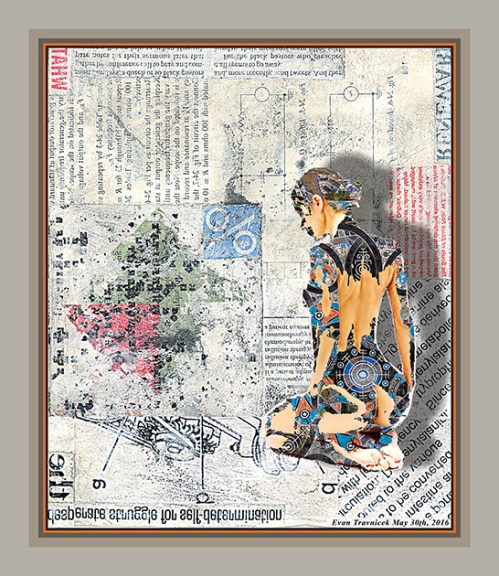
I’m just noting the trend with tattoos. I’m also linking that trend with this new work of mine. Sophia, the name for the model I used in this piece, looks like she has large areas of tattoos on her integumentary system. The pattern of this tattoo is Meme Catcher, an altered illustration of mine that I blogged about at the end of 2015. In Gnosticism, Sophia was the syzygy of Christ. In other words she was the feminine expression of Christ.

Sophia is a Greek name, which means wisdom. Wisdom is connected with knowledge, but I’m not sure if they mean exactly the same thing. When it comes to non-physical terms, such as intelligence, knowledge, and wisdom, it becomes much more difficult to define and separate the terms so that they are understood in isolated and individual ways.

The tattoo on Sophia’s body looks like it has depth to it—like it looks like you are peering into another dimension—and the frame of Sophia’s body is the doorway as her skin peels away in a metaphysical apoptosis in her meditative physically unbinding state. She is sitting in a meditative posture I learned in Karate called Seiza. It is a posture from which a person can get up easier than from a full lotus meditative posture. Karate, by the way, is another activity Americans engage in as a hobby, which—not surprising to me—involves contact and touching other people.

In this image, however, the model is alone. She sits alone. While being alone isn’t necessarily necessary in order to meditate, it does create a state conducive to more intimate contact with the universe, God, one’s higher self, or whatever however. I put a drop shadow to the right of Sophia giving the contents past her body a sense of depth as if they were on a wall.

On the lower left hand of the picture are the words are “desperate struggle for self-determination.” I like the chasm your imagination engages in to find connection between a young woman meditating and whatever image you get for a “desperate struggle for self-determination.” The way I interpret that is that decision-making truly lies within oneself, and is acted on by oneself and oneself alone. Hence, the singular meditative figure.
Leave a comment

May 31, 2016 · 4:52 am

New York Station (version 1)

NewYorkStation1ematted

I’m filling a national need here by overwhelming you with visual clutter. Since I’m an American in this current lifetime, I can’t help but let my artistic sensibilities express contemporary perceptions, imbalances, desires, dreams, and lacks in America’s collective unconscious. Of course, I can’t speak for everyone, but I can take a slice out of American pie and help you take a bite out of it with your eyes.

This piece is actually inspired by a pal on Twitter of mine who is a remarkable poet, and the song by The Velvet Underground called Rock and Roll. Rus Khomutoff, on Twitter, sometimes sends me links online of radio stations in New York because he’s from Brooklyn. I’ve never been to New York myself, but I sometimes think my vibe would jive well with certain scenes, cafes, dance clubs, music stores, galleries, and bookstores there.

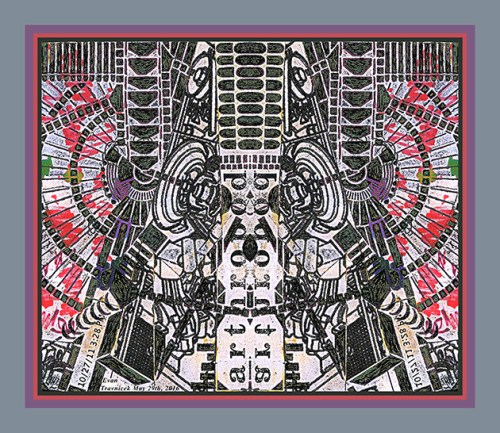
This piece has also hints of Japan’s Rising Sun flag. Recently, President Obama made an official apology to Japan for the United States’ annihilation of Hiroshima and Nagasaki for the end of world war two. Washington and Wall Street helped to industrialize Japan after world war two, and I think that the mechanical engine parts represented in this piece are symbolic of that.

Another association that comes to mind is Depeche Mode’s Music for the Masses album, and how its front cover has sound megaphones attached to a pole on a landscape. Is it dawn or dusk in that image by Martyn Atkins? If it is indeed dawn, then that’s just one more link to Japan’s Rising Sun flag.

A pastime ritual of some Americans is collecting things, from coins, to stamps, to all kinds of retro and antique objects. I think this piece helps to convey that sense. After the Great Depression of the 1930s, my grandmother clung to a tendency to hold on to things, even items of trash. In my six year stay with her and my parents on our family farm, I started using some of that trash, media, and old materials from the past for art projects.

The need to have things together, to have enough to survive, and to be able to be within reach of necessities come to mind. Unconsciously, if many Americans could, they’d probably grab every other nation on the planet and pull them close to the United States for close monitoring and access to resources. The word arthropod transverses the middle of this illustration, indicating an organism, such as an insect, that uses feet, limbs, and joints to walk, thus implying the need to walk across water as an act of faith to touch other things and organisms.

My work here is part of a larger series called Mechanical Organisms, which is part of the overarching Micro-Chimerisms project that continues to be ongoing in the Art of eVan repertoire.

1 Comment

May 29, 2016 · 5:55 am

Candy’s Candid Chaos (version 1)

CandysCandidChaos1ematted

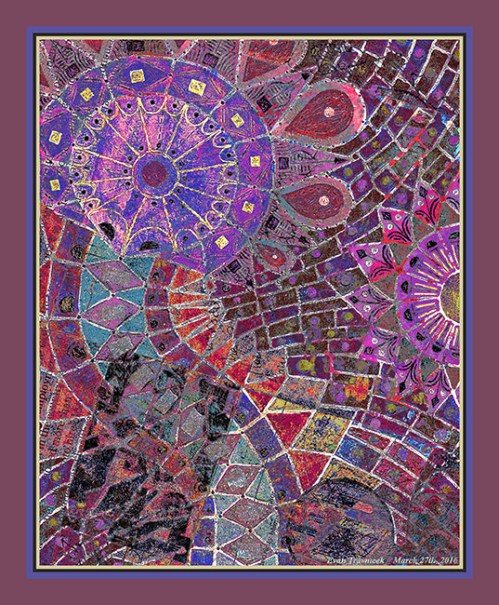
Arising from a piece I created called Mechanoreceptors back in 2012, Candy’s Candid Chaos was recently formed. I have been wanting to continue working on the female form in combination with my arabesque and mosaic designs. A lot of unexpected synchronicities occurred in the process of creating this piece.

I selected the silhouette from a picture of a nude female and placed my drawing, Mechanoreceptors, behind it. I unwittingly created a background for her form without knowing that it would become the background later. Then I selected the design filled silhouette and placed it on the background as the foreground. I’m enjoying it because of how the image, as a whole, merges together nicely due to the color combinations, and the intricate mosaic pieces.

The head of the woman looks like it has a gust of wind, or a breeze, wrapping around it. The circular shape circumscribing her middle torso fits together nicely with the left hand border and the rest of the background.

As a whole, this piece looks like it’s more random, rather than premeditated and organized by your average artist. The unexpected results from chaos and experimentation are what I have practiced for many years now. I feel this piece exemplifies that well. I named the female Candy in this piece. I imagined that Candy enters a world of chaos sometimes so that she can merge with its infinite, less defined nuances of imagination and space.

Chaos, being the original state of creation, gives rise to inchoate forms as they seek more and more definition as time unfolds. In this rather undefined state, Candy seeks a candid exposure of her multifaceted expressions.

As an artist, I have found the female form to be one of the most enjoyable forms to study and master drawing and painting. I gather endless inspiration from the female form. It seemed appropriate to me to add a hint of a story behind the female forms I sometimes use in my art so as to add a dimension of depth and character. I would like to ask some of my female friends some stories they’d be willing to share with me so I can expand upon them with my art and my writing.

Leave a comment

May 14, 2016 · 6:20 am

Prayer of a Pillar (version 8)

PrayerOfAPillar8ematted

The idea here is a beautified, glorified, abstractified column. It became apparent to me as I was exploring other design configurations. This piece is derived from, believe it or not, Ataraxy (version 1). Of course I combined Ataraxy with a few layers of other material. Another example of that result is the piece I posted here back in August, 2015, called Galactic Template (version 2).

As far as common history is concerned, the architectural usage of columns dates back to ancient Egyptian times of around 3000 BCE. The ancient empire of Egypt is said to have originated in that time period. I only theorize that there could have been great civilizations, not alluded to in contemporary history books, that existed thousands, and perhaps tens of thousands, of years prior to ancient Egypt. Associate professor Robert M. Schoch has done considerable research revealing civilizations our current model of history ignores.

I chose to post this piece now because I had noticed my recent usage of the word “column” in my micro-blogging. My blogging is, of course, influenced heavily by what I notice going on in the world, and by other professional bloggers whose information and insights I value. I like to rely on my intuitive sense of informational flows; one way I do that is by noticing repeating patterns, including words, sounds, and images… even feelings. Perhaps especially feelings, as feelings are the place from which most people make decisions anyway.

A column can define a column in a newspaper, or it can define the architectural noun. To me, a column is a symbol of strength, civilization, calculation, order, governance, continuity, and stability. Perhaps this sense is intended to be communicated by journalists’ official use of columns.

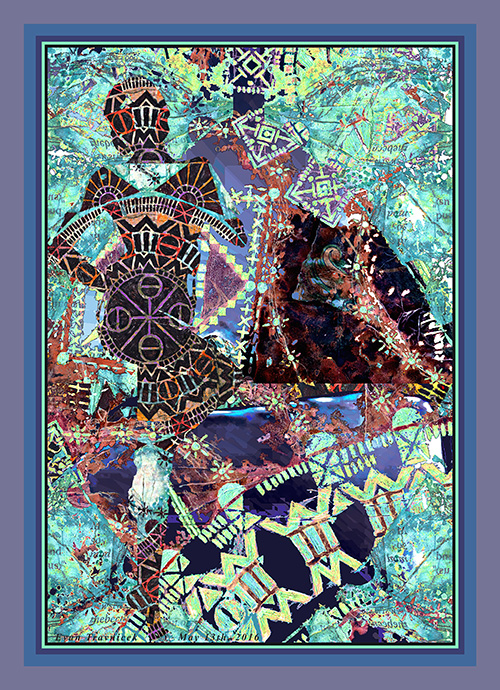
At the bottom left and right of this picture are what appear to be stalks of grass, composed of black mosaic pieces. Or maybe they are skeletal impressions of hands beginning to cup and shroud the base of the column. Anyway, whether if the finger-tips of grass, or the phalanges of hands, they look like they are moving into a praying clasp. Hence, the title for this piece: Prayer of a Pillar.

The metaphorical, amorphic fingers merely suggest the form of hands as if each mosaic piece is obeying the non-physical commands of an unseen field moving them to pray. I’ve seen imaginary depictions of what it looked like in ancient Egyptian buildings and temples, and it appears that Egyptian artisans and their governing priesthoods liked to use bright, bold colors to fill in the shapes, forms, hieroglyphs, and figures engraved on their walls and pillars. So my idea of a column here has a more Eastern and ancient character to it, rather than a Western, colorless, marble quality.

This piece has a lot of detail in it—a quality I wanted to achieve—with an appealing sense of balance and order. As many other pieces of mine, this work looks like it could be a still of a kaleidoscope. I also like to imagine that you are looking through a microscope at an exotic, alien world other than what you might normally see as cells and microscopic debris. After all, one of my original pieces in the Micro-Chimerisms series is titled Microscopic Works of Light.

I may add that the black mosaic phalanges coming up into a prayer formation at the bottom of this illustration can also be seen as the petals of a lotus flower. The lotus flower is an Eastern symbol of enlightenment, as they blossom on the surfaces of muddy bodies of water; from the depths of darkness, illusion, suffering, and mud is born enlightenment. So I’m really combining the Western prayer, the column of strength, and an Eastern symbol of enlightenment here.

These layers of materials, collages, drawings, and texts, along with multiple multi-layered symbols creates an idea I want to communicate to you: That we are multi-dimensional beings who perceive multiple meanings in the vast perceptions we receive and emit everyday.

Leave a comment

May 2, 2016 · 1:13 am

Planet Hunting (version 1)

PlanetHunting1ematted

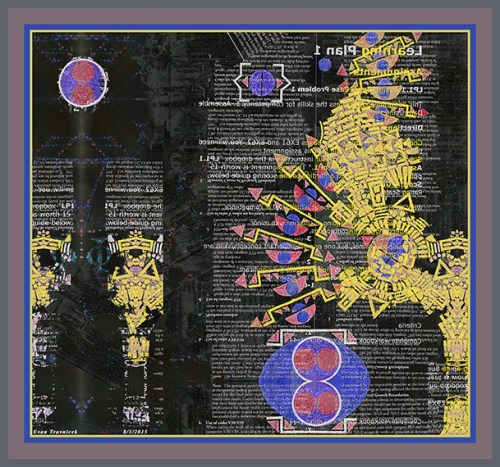
This piece is derived from Ataraxy, an addition to my Micro-Chimerisms series, that I created last July (2015). I made several other variations from Ataraxy, but I felt this piece was the strongest. There are four other versions of it stored away for future viewings, projects, and shows.

I titled this structured melange Planet Hunting. I did so because the abstract mechanical object on the right of the picture plane looks like it could be a strange observatory that has several arrows pointing in a spread of degrees as if they were moving skyward. There’s a circular object in the upper left of the picture plane possibly suggesting a planetary body.

I like the notion that this image communicates the idea of aiming high, of shooting for the sky for one’s dreams. The dark background gives the mood that probabilities abound in the mystery, in the folds, in the countless unseen waves of space and time. There are what appear to be pillars on the lower left indicating an ancient civilization. Could it be Greek, Roman, or from the civilization on another planet?

Comparing ancient historical columns to textual columns was done half intentionally here. As I mentioned, this piece is derived from Ataraxy. I developed the columns, not from my original drawing, but by manipulating, copying, and combining new elements on to new picture files. It just happened to be that textual columns stood readily behind the digitally assembled yellow columns standing in front in this version.

There’s a large caldron or round iron oven in the low center that seems like it could be the dominant center of interest for the entire picture. But the fact that it’s dominant color is blue makes it a cool retreating hue. The yellow in the mechanical observatory off to the right and the columns on the left advance on the viewer as a louder warmer color balancing out the play of all the included shapes and objects illustrated.

Nevertheless, the round, blue, strange oven-like object still looks like it’s in the foreground, even though it’s primarily colored with blue, and secondarily, red. Perhaps it could be a steam engine, implying an abstract steam-punk setting. I like some steam-punk styles, but that’s not the core approach of my style, and the ideas I want to communicate to you. I like exploring imaginings of abstract alien technology, and obscure, archaic equations forgotten about in the vacuous, unfathomable echoes of our universe, and perhaps alternate universes.

I drew brackets, deltas (triangles), half-circles, and circles in different formations relaying my ongoing love of mosaic styles. As you may know, mosaics are how I see most everything when something is broken down—or seen—in its smaller elements. I like knowing what things are made of, and color coding helps me identify each part or element for the orders of greater and greater constituencies. For example, all the different organs of the human body are assembled into one unique organism or individual.

Of course we could explore the non-physical entity that animates and holds an organism together according to biological scientist Rupert Sheldrake’s theories of morphological resonance, but I recommend listening to any one of the talks or interviews of Sheldrake that you can find on Youtube.  He implies that organization is done by non-physical intelligent design.

Leave a comment

April 28, 2016 · 6:26 am

Toilet Scrubber (version 4)

ToiletScrubber4ematted

Toilet Scrubber (version 4)

35 X 30 inches

Print of drawing, cutout/collage material (paper and digital)

There are causes for which I named this piece thusly that I shall leave up to other parts of your mind to figure out. In the meanwhile, let’s explore for a few moments why I used the words I did here. The round headed object repeated at the center of interest looks like a toilet scrubber with its bristles and handle.

I thought of titling it Toil Rider, as one sort of rides toil when one cleans the bowl of one’s toilet. I wanted to give the image a sense of adventure and fun however, while mocking a chore that requires attention regularly. But then I just thought, “what the heck,” and I decided to just call it Toilet Scrubber. After all, that’s what it looks like. At least to me.

There are several toilet scrubbers in this piece. It looks like several repeated frames of a toilet scrubber in movement as it swishes around the bowl. Though, initially, you might be repelled by the whole idea, this piece would go well with your bathroom. It can serve as a diving board for inspiration as you ponder upon things while mentally belaboring one thing after another.

I combined an airplane view looking straight down at some industrial sites with a Micro-Chimerisms mosaic I’d drawn. The Micro-Chimerism I drew was drawn on the page of an old coffee table book exploring paranormal phenomena. I like doing ostensibly random things like this—layering seemingly unrelated subjects and items—in order to create new dynamic orders.

Leave a comment

April 24, 2016 · 6:51 am

Clocking the Mess (version 4)

ClockingTheMess4ematted

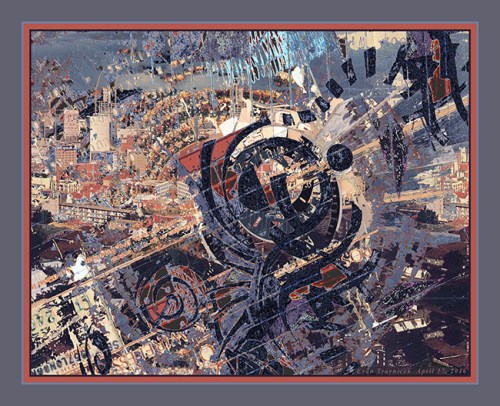
Creative destruction is the main theme of this hybridized collage. A few days ago, I cut out some images and text from a few old magazines I’d purchased at second hand stores. At the time, I fit them together into a spoked wagon wheel composition. I wasn’t exactly sure how I’d use them in a future design. Here is the result of that initial inspiration.

Earlier today (Sunday, April 17th, 2016), I was drawing some of my energetic abstractions I’ve developed over the years. After leaving the cafe I was sitting at, I started getting some ideas on how I’d use the cutout magazine material I already mentioned. I also knew I wanted to incorporate the drawings I’d just done. Upon returning home, I started scanning in the magazine cutouts and the drawings. Then I transferred them to my image editing program.

While at the cafe, I was listening to some classical music I feel explode with power and thrust. You see, when I first came to the cafe, I was listening to a classical station on the radio in my truck. They were playing Dvorak’s Slavonic Dances. I could feel the power chords resonating in that piece, but I hadn’t consciously formulated that assessment in my mind at that point.

So while I was in the cafe, I decided to listen to the Slavonic Dances on my iPhone. Then I decided to listen to the Overture of William Tell, by Rossini. I intuitively sought out more music I felt also had a powerful thrust to it. Then I thought of listening to the Ride of the Valkyries, by Richard Wagner. I topped off my desire for forceful, thrusting, power music with Tchaikovsky’s 1812 Overture. Tchaikovsky’s Overture was an excellent climax because of the cannon explosions that can be heard in it towards the end.

While listening to the last two pieces I mentioned, I started to write some of my thoughts down. As I mentioned, this piece is about creative destruction. It symbolizes the awesome creative / destructive power of natural phenomena, such as tornadoes, hurricanes, and vortices in water. The power of the classical music I listened to felt excellent for inspiring a person to clear out mental detritus, such as anxiety, hesitation, procrastination, cowardice and so forth.

I feel that destructive forces in nature are necessary forces that clean away old, rotting, obstructive, stagnating, lingering elements that have already served their purposes in the greater balances that constantly fluctuate throughout the universe. In this imagery, in which several parts coincide, I combine the power of thrusting, forceful classical music brimming with confidence, and an abstract depiction of a hurricane. It looks like the dark, swirling vortices have approached from the upper right from an ocean on to the bay of an old city, heading down across the land to the lower left of the picture.

The complex detail of the cityscapes, skies, and text would be near complete chaos if it weren’t for the wagon wheel composition around which they are all assimilated. I made sure there was also a straight line transversing across the entire picture plane. Another symbolic dimension I imagine that can be highlighted in this piece is a bow and arrow with the arrow aiming towards the upper right. I like to see multiple things in the abstract works of art I create. I am pleased when people see things in them that I’d never thought of.

I intuit that people generally gravitate towards art that isn’t too complex and chaotic. Identifiable objects, and simpler abstract shapes, are concepts people can grasp and feel senses of confidence and security with. An approach I’d been experimenting with for a while now is complexity. A philosophical idea I’d been pondering lately has to do with a polarity between absolutely void space, and completely filled solidity.

Art works that are amassed in complexity and chaos approach a paradox for me. I considered the notion that space is perhaps the ultimate filled solid, but its “matter” is so infinitely subtle that it appears to be a vacuous medium through which we can travel. Space, being one side of the polarity between itself and total solidity, is really just part of a polarized environment of creation. This ultimately makes matter and space one when looked at holistically; being and nonbeing are also dual parts of this greater existence. But the play of contrarieties must continue in order for the fluctuating spectrums of all existences to differentiate and experience something other than absolute unity.

In conclusion, I titled this piece Clocking the Mess because I used a magazine cutout of the face of a watch. Of course it represents time, and the main line transversing the picture represents the traditional Western linear concept of time. It also highlights the pathway for which the abstract hurricane is traveling across. The “mess” is all the intricate detail characterizing the image as a whole.

Leave a comment

April 18, 2016 · 7:27 am

Be To The How (version 9)

BeToTheHow9ematted

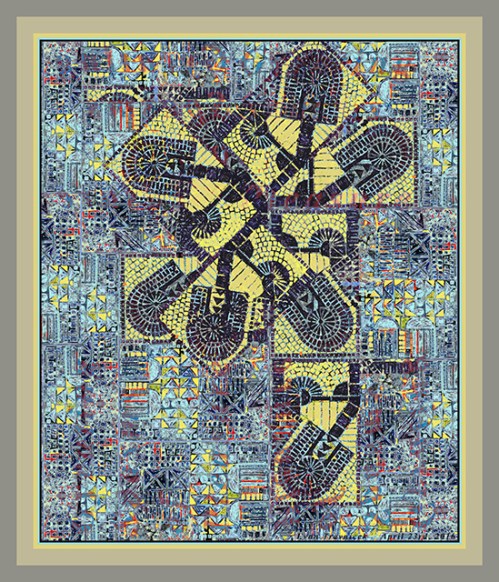
Meander across the page, does a weaving path of mosaic shapes in this illustration. I wanted to use one of the paper collages derived from various books, printouts, and lists I’d made over a year ago. The particular collages I used had been sitting around for a while because I didn’t feel bold enough to tackle the projects I knew I wanted to carry out on them. The collages came from a large eighteen by twenty-four inch piece of paper on which I glued various other paper media materials to. I cut up the collage into smaller pieces, thus providing myself future material for more works than one, though smaller.

Here is the result of what I drew on to one of the cut out collages. I didn’t feel bold enough to engage in these preparations because I was worried that I wouldn’t make anything that would satisfy the standards I’d set with previous successes. In an instant, I decided one day—a few days ago—that I would just start drawing on one of the collages with some magic markers that I have readily available in my little studio.

The result here is identical to the original drawing in composition, but not in color. The colors in this version are completely different. After tinkering, filtering, and manipulating other versions, I came to this version number nine, and felt a degree of success that satisfied me. I hope it visually satisfies you, too. Art is like food for the soul, and eyes are like the mouths that consume art’s cornucopia of visual taste and experience.

A friend had mentioned that my art looks “Kleeesque” to me one time, and I hadn’t thought about Klee’s art for some time now. I used to be very inspired by Klee’s work years ago. I remember checking out a huge book from the downtown library in Riverside, California on Klee’s work a long time ago. I would listen to Tchaikovsky’s Nut Cracker Ballet after I took the books home I checked out at the library, and turn the plates of images of Klee’s art in color with awe.

I used to be obsessed with Van Gogh’s art; I wanted to paint exactly like he did. I did a couple paintings and drawings that resembled Van Gogh’s style, but mostly I felt frustrated that I couldn’t do what Van Gogh did. At a certain point, I started asking myself if I wanted to be known as an imitator of Van Gogh’s art. I realized that I wanted to develop a style of my own. In my studies of other artists, I found the cubists, the surrealists, and Paul Klee to help me explore other avenues of expression. I resolved a sense in me that I would use Van Gogh and Paul Klee as a sort of polarized standard for which I could bounce back and forth the ideas of my own that I was developing.

This digital representation harkens me back to that stage of development in my artistic career. I titled it Be To The How as a poetic play on words. While there is no bee buzzing around in this organic portrait, it seems like there possibly could be. Nonetheless, “be,” as in “being,” is an existential notion, and I felt that the relationship between being and action (how to) was a pertinent observation. It looks like a being—perhaps a worm—is learning how to travel across a forest of grass and flowers as it stumbles across a bit of enlightenment for it’s culminating lesson for the day.

You can see some of the text and graphics from the collage showing through the colorful shapes I’d drawn on to them in this piece. In future projects, I’d like to let the graphics and text be less covered up by my drawing so as to give more play and emphasis to the collage work I accomplish.

This piece is 23 x 19 inches

Matted, glassed, and framed, this piece is: $400.00

Postage and handling is: $50.00

For a total of: $450.00

(I recommend you get the print glassed yourself, instead of me glassing. This is so you can avoid possible broken glass when you receive it).

Price for an unmatted print is: $90.00

Postage and handling is: $5.00

For a total of: $95.00


Buy Now Button

PayPal Acceptance Mark

Leave a comment

March 27, 2016 · 7:53 pm

Whispered Context (version 4)

WhisperedContext4ematted

Whispered Context is what I call this one. The female form visually whispers to the reader of the text as one reads it. It’s too obvious here to be a subliminal communication, but it implies this concept anyway. The last image I did like this I blogged and showed you, called New Morals, captured a new idea I happened upon in my lucid states of creativity.

I read Facebook’s rules concerning showing art with nudity in it, and it sounds like they are okay with it. After all, busts of the Greek statue David can be found pretty much anywhere, so I felt confident in sharing this image with you. This new series I’m developing reminds me of Greek statues, what with their marble statue resemblances behind the lithography of text.

As is a well-practiced art now, I used reversed and flipped text in this piece to bring attention to the shapes, patterns, and groups that letters, words, and sentences form. The designers of fonts put a lot of effort into designing letters so that they allow the eye to flow across them as they are read. Johannes Gutenberg, the inventor of the printing machine, back during the Renaissance, even did mathematical calculations for the characteristics of each letter, such as the middle part of o’s being wider than their tops and bottoms for example.

The foundation of this digital illustration is a collage. I pasted texts, words, and paragraphs from different sources together at different angles. They are all perpendicular to one another however so as to create a degree of stability. The piece as a whole is vertical, making it nice for near a doorway perhaps, or any other area of your house that can allow some vertical space.

As I mentioned previously, I’d like to use portraits of people who are interested, and incorporate them into future works. The face, I find, expresses so many things for people. People are just drawn to faces in art. I wanted to combine undefinable abstractions (such as reversed and flipped text) with the human face and form in order to create a synchronistic synergy. You may notice the text next to the left of the woman’s hair, creating an effect that looks like a breeze or wind is blowing her hair to the left (her right).

Another synchronicity I played on is how the woman’s eyes are right next to the bold text “EYES,” drawing attention to that area with your own eyes. Eye contact is another powerful connection people make with one another all the time. In art, I believe it’s a centering, and deliberating contemplation you can make as you wonder how this specter moves so well through all the black and white print as if she were made of a liquid lighter than water, combing with ease through all the denser materials collected together in this space.

This limited edition print (limited to 25) is: 30 x 20 inches

For: $90.00

If you want it framed with glass, it is: $400.00

If you are not satisfied with your purchase within 60 days of purchase, you can return it to me for a full refund.


Buy Now Button

PayPal Acceptance Mark

Leave a comment

March 25, 2016 · 5:10 am

Apex of a Heart (version 5)

ApexOfAHeart5ematted

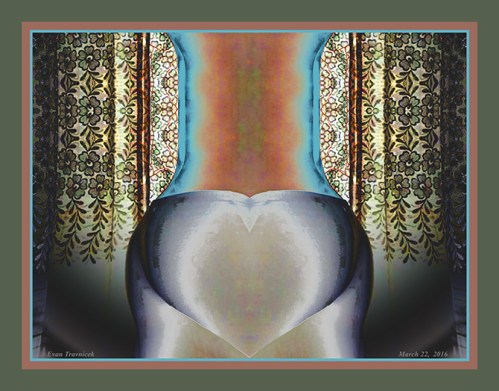
What is this? It looks like the shape of a cartoon heart at the bottom center. I didn’t realize that I would get this shape when I was in the process of manipulating the photograph from which it came. I think I will let you figure out the source. I mean, it’s pretty obvious, isn’t it?

I wanted to turn the digital photo I was working with at a certain point into the shape of a vase. But the heart shape didn’t resemble the bottom of your typical vase. Therefore, I decided to title this piece Apex of a Heart. In anatomy and physiology, the apex of the human heart is at the bottom of the heart. I found this to be contradictory when I learned about that because when I normally think of the word apex, I think of the apex of a mountain, which is its peak.

Anyway, to overemphasize the “bottomness” of the heart’s apex, I made the point of the heart you see in this image touching the very bottom of the picture plane. The curtains behind the central form give you the sense that they entirely surround it, hiding it from everyone’s view (except yours) as a strange anomaly that oddly resembles something you can almost identify.

I filled in some holes and gaps to touch up the continuity of the form and the curtains. I made other variations of this image, which are more colorful. I decided however that I would like to use this fifth version to show you because the colors weren’t too jarring. Not that jarring colors are bad in general, it’s just that for this piece I felt I balanced this palette well enough after the second day of working on the visual document.

I would like to work with the human form to create more abstractions like this in the future. I would like to work with portraits of friends and acquaintances and incorporate them into my textual artworks. You saw an example of that in New Morals. If interested, send pictures of yourself with minimal background so I can select your image and put it into new works. This theme, and many other concepts, I’m developing currently. You’ve seen my other themes already, so I don’t need to explain them.

The diffuse glow, the soft feeling of cotton, and the exclusivity that this piece invites you to feel makes it an intimate experience. The nice thing about it is that you can return to it and remind yourself of it again and again. Just imagine having it as a limited edition print (25) in your collection of art from original artists. This print is 23 x 18 inches. Just the print itself is $70.00. Remember, there are only 25 that I will make, thus insuring their value for those who own them.

1 Comment

March 22, 2016 · 8:10 am