Blog Archives

Individuality Formations (version 3)

IndividualityFormations3ematted

I realize that some of my readers and viewers tend towards Marxism in their political leanings, and others tend towards capitalism in their views. The reason why I start out this blog mentioning such topics is because this piece is actually inspired by what I’ve learned about those ideologies, and some of the histories behind them.

Earlier this year, I read Karl Marx’s doctoral dissertation titled: The Difference Between the Democritean and Epicurean Philosophy of Nature. I would not describe myself as a Marxist however. What I’ve learned about human nature and history has shown me that powerful centralized authoritarian governments are opposed to human nature, while paradoxically being products of human nature.

Marx describes the ancient Greek philosophy concerning the atom in his dissertation. The Greeks understood the atom to be the most absolute undivided point in nature that composed physical matter. The atom was thought to be completely free of any opposition to itself, and completely indifferent to its surroundings as a unified individual unit of matter. Everything constructed from aggregations of the atom are often opposed to one another in one way or another as can be observed throughout the kingdoms of nature and life.

I recall seeing the spiral pattern on ancient Greek pottery, as well as in Celtic art, as well as in patterns in natural formations. For a while now, I’ve been noting how the spiral pattern is nature’s resolve to seek balance and harmony. In physical states, nothing is at rest. This suggests that peace is never a state that can be found while anything exists in physical nature. The desire to attain peace is so great, however, that patterns of movement and formation throughout the universe form spiral shapes and forms in response to the incomplete, unstable, conflicted, and insecure nature of physical matter, or illusion.

This understanding extended into what I’ve learned in my medical studies as a health information professional, and my understanding of human psychology. To get to the point, the body’s autonomic system has a flight or fight response mechanism built into the instincts as a way to deal with threats in the environment. The body responds to perceived and possible threats by increasing the heart rate, deepening the breathing, and constricting the vessels in the extremities of the body.

In my research into psychology, behavior, and social dynamics, I have learned how projections are formed, maintained, and how they are let go of. Basically, a person’s emotional state is the determining factor in how a person will respond to a given environment or situation. Regardless of how another person, who is interacting with the overwhelmed person, really thinks or feels, the person projecting will interpret the person’s behaviors he or she is with negatively, and as possible threats.

This frequently develops into further misunderstandings and conflicts because the person who is being projected upon usually has psychological triggers, and flight or fight responses designed to protect his or herself. This is how I’ve seen many a political debate transform into. People who argue politics, such as the belief systems of Marxism and capitalism, hold their beliefs so cherished and dear that it literally feels like an attack on one of their most precious resources when another person tries to provoke them by highlighting their inconsistencies.

On a global scale when we look back at history, we can see that Hitler’s fascist regime was so absolutely against Marxists and communists that he condemned them to the concentration camps he designed as a “final solution” for anyone who didn’t fit in with his idea of a political economy. On the same note, communists were diametrically opposed to the Nazis. Even to this day, Russians are very quick to single out anyone they suspect of having ties to Nazis. This is one of the reasons why Putin is in Ukraine. He wants to protect Russia from, first of all, Washington, and second of all, the Nazi organizations Washington apparently finances.

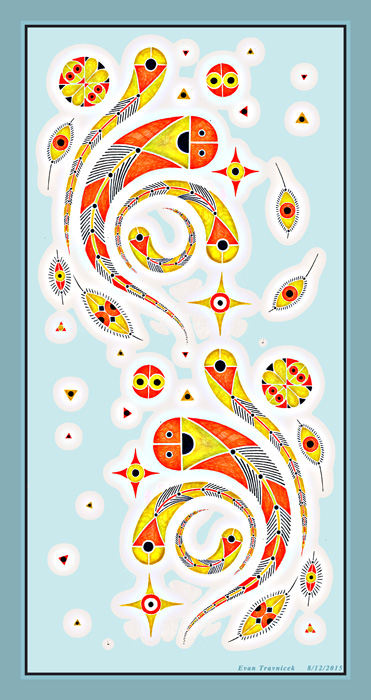
So, in conclusion to this blog, I titled this piece Individuality Formations for all of the reasons I just discussed. The fish-like organic figures composing this piece are swimming in spiral-like formations. There are two groups of them, equal in size, symbolizing the Ying Yang philosophy of opposition, harmony, conflict, and balance. Fish are like muscles in the human body. The body’s circulatory system is composed of muscles that constrict and dilate in tandem with the heart, which also is a muscle, beating in rhythms of diastoles and systoles.

References:

Marx, Karl. (1902). The Difference Between the Democritean and Epicurean Philosophy of Nature. with an Appendix. Dissertation retrieved from: https://www.marxists.org/archive/marx/works/1841/dr-theses/

Reich, Wilhelm. (1933). The Mass Psychology of Fascism. Published by Farrar, Straus and Giroux.
Leave a comment

September 14, 2015 · 6:37 am

Mo, The Molecular Orbital (version 1)

MoTheMolecularOrbital1ematted

Are you an act, or are you an object? Are objects really just immaterial acts, continuing on a set of processes until they morph into something else? Well, that’s the idea here… or, at least one of them. Molecules and atoms are made of smaller particles. No one has found the one indivisible particle upon which all material reality is constructed yet. There’s enough evidence, in my opinion, that no one single and final particle will ever be found to explain the physical plane.

I rather found my philosophy on notions that our world is just energy at its foundation, fixed and stationed in certain frequencies, patterns, and repetitions. From a bird’s eye view, I see everything in circular, cyclical, galactic, and hurricane-like formations—just wind, energy, and self-contained energy (particles) swirling around experiencing something other than rest, peace, absolution, and undisturbed unity.

The idea behind this drawing particularly came from seeing images of some hydrogen orbitals. In science books and literature, models of atoms look like solid billiard balls. This is of course founded in Western science’s obsession with physical matter, and hard matter being the explanation for everything that ever existed. Well, when real pictures can now be taken of hydrogen atoms, one sees that the particle is rather more like a cloud with varying degrees of density; a hovering nanoscopic act, self-contained by a rudimentary awareness.

Philosophers used to discuss the atom because they thought that it was the perfect indivisible particle on which reality was made. Philosophers, such as Epicurus, Democritus, Herodotus, Aristotle, and even all the way up to Karl Marx, believed that hard matter was the explanation for everything physical. In fact, some of them, like Marx, believed that hard matter was the ONLY explanation for anything, and anything hinting at mysticism, non-physical, or the paranormal were just the delusions of possible madmen.

They were trying to find a plane of existence in which the individual person could find ataraxy—a state unperturbed by the lacks manifested in physical reality. The word individual really means pertaining to being undivided, unified, and therefore lacking conflict. I mention all of these theories because I’ve been on a search to explore the self, myself, others, and what reality is.

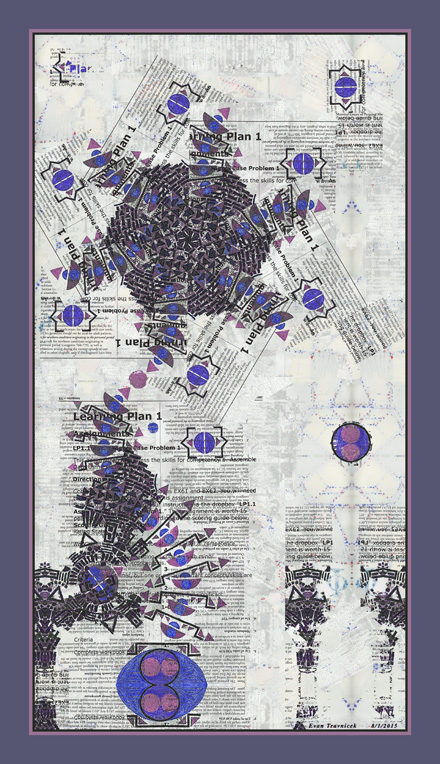
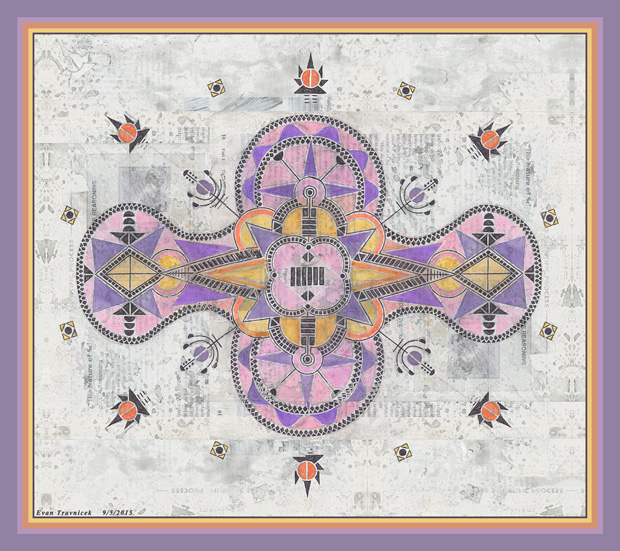
In my searches and explorations, I frequently make drawings and diagrams to give further detail as to what I’m understanding. This is another drawing in that journey. It gives a visual idea of smaller and smaller particles constructing greater and greater wholes; organic, if you will. The objects that manifest in drawings, such as these, are usually permeable—that is, the mosaic bits and pieces render them as lacking solidity, while also suggesting energy and some tension.

The original drawing for this image isn’t as complete as you see here. I had to copy and repeat the binary aspects to it to give it a whole and proportionate body. I just didn’t have enough space with the paper I was drawing on, and I knew I would be able to finish it up in a digital editing program, so, instead of taping more paper to the original paper, I completed what you see here on the computer. It still looks like a paper drawing for the most part. You can see some of the text embedded in the layers popping out. The text and paper is from an old school science textbook.

Leave a comment

September 6, 2015 · 6:57 am

Yoga of an Inter-Dimensional Carnation (version 3)

YogaOfAnInterDimensionalCarnation3ematted

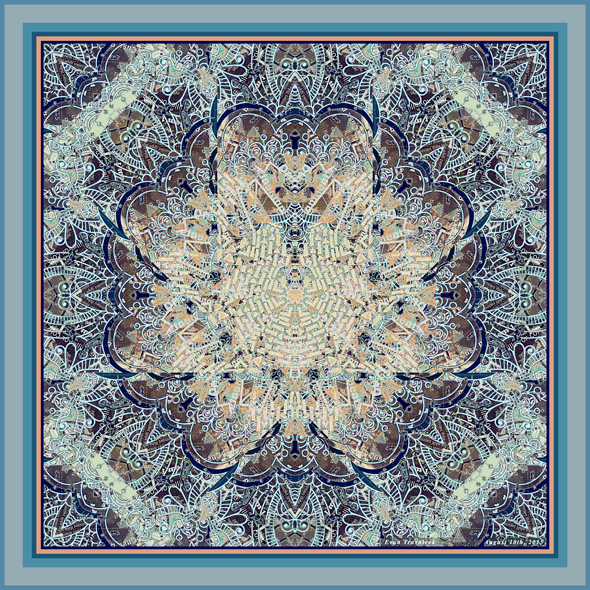
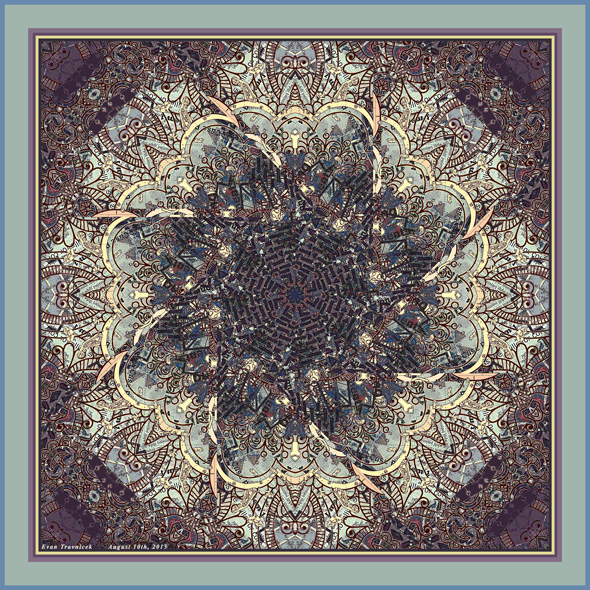
It looks like you could almost place both of your hands on the pattern forming the center of this image. I almost used the word “prayer” as part of the title for this piece, but I decided on the name Yoga of an Inter-Dimensional Carnation because it looks the petals of the flower have arms along side them that are reaching upwards in eight different phases, as if to complete a yoga pose.

I suppose prayer and yoga can be compared as similar, but I would have to say that they are not exactly the same. Prayer, to me, is an intense focusing of one’s desire addressed to a higher source, such as God, and yoga to me is about a lifestyle accompanied by regular breathing and muscle exercises. Yoga is a purifying of one’s self so that one’s prayers can be more readily and immediately answered, quickening the process of oneness with the universe, and relinquishing emotional and spiritual debris.

A friend of mine on Twitter gave me some valuable insight about who my audiences are, and who my art would appeal to. She gave me all kinds of ideas about what the patterns I create could be put on, such as satchels, rugs, shower curtains, bags, purses, shoes, and even jewelry. She said that many of my designs would appeal to kids, as in putting them on lunch boxes, and for games, and so forth. It became overwhelmingly apparent that my art appeals particularly to women’s and children’s tastes.

These audiences weren’t necessarily my target audiences, as my mind had been more set to appealing to art collectors. I hadn’t intended my art for household items, utilitarian objects, and women’s fashion, but I totally can see how all that would work. I’d even be excited to work with some manufacturer or another and to contract my work with some of their projects and fashion designs for the mentioned areas.

This image worked well because of how the paisley designs show up so well, giving the space surrounding the lotus-like flower at the center a sense that this could be an intricate and ornate table cloth for a very nice dining room. You can’t see the text very well from the printout material I used for this amalgamation, nor can you see the engine diagram material very well as well. Because the detail is so rich, an owner of this piece as a print would continue to be pleasantly surprised to encounter new things in it all the time.

Though this image was completed before I completed Galactic Template, I posted it after Galactic Template because I felt more impressed by it. It has a shimmering quality of light, delicacy, and subtlety that the previous piece doesn’t seem to encompass as well. I was able to pull out the center with orange and yellow hues so as to offset the cool glow of the picture with a warm central glow, all finished in pastel highlights.

This piece shows you the unresolved struggle I had in trying to make the central mosaic patterns complete a circular design. As I mentioned, the center looks like a pair of hands next to each other with the thumbs overlapping. I couldn’t figure out how to get rid of the finger-like extensions breaching the circle. I felt good about this design, so I took a tangent off with it and created four different versions of it. To see how the completed circle at the center looks like, see Galactic Template previous to this post.

Leave a comment

August 11, 2015 · 5:41 am

Galactic Template (version 2)

GalacticTemplate2ematted2

Engine diagrams, paisley designs, printouts from my health information technology classes, and material from two of my Micro-Chimerisms drawings went into the creation of this image. The process was particularly challenging for me because I wanted to create a circular design with equally distributed repetitions from another image created from the earlier sessions I embarked upon to create the Ataraxy series overall. So, yes, this image is part of the Ataraxy series. Please see the post listed as Ataraxy (version 1) to see if you can find any of the crossover in the details.

I also used another Micro-Chimerisms drawing for the more clearly apparent black mosaic pieces forming the inner mandala design at the center parts of this illustration. I had been wanting to create circular patterns and designs resembling kaleidoscopic compositions in the image editing program I use this time, instead of just relying on drawing them long-hand. While I have fun drawing my intricate mandalic designs long-hand, I knew I could take it further on an image editing application.

The variations on a theme exponentially multiply once I start playing around with the material I create by traditional means and scan it into digital media. The challenge I encountered with this piece was figuring out how to uniformly cascade the overlapping sections so that they overplayed each other in regular pre-calculated intervals. I had to manually calculate the degrees at which each section would be positioned. This image portrays eight segments which overlap each other like a pinwheel.

In my ongoing fascination with mandalas, I find that all sorts of poetic associations can be made with my finished products, enabling imagination evoking titles to be given. For example, since there are eight sides or segments composing the spokes of this design, an association can be made with Buddhism and the Eightfold Path, which are spiritual disciplines involving yoga; it looks like a lotus flower, or, at least, some kind of flower with petals; it looks like a pinwheel; it could be a spinning sparkler; and it could also be highly stylized depiction of a spinning galaxy.

So I titled this piece Galactic Template. I was trying to think of a different name other than supergalaxy as an allusion to one of the first galaxies formed at the beginning of time. That is, time and the origins of our known universe as 20th century scientists have determined. Who knows? Perhaps the models, theories, and constructs present day astrophysicists teach are merely myths like how we know ancient Greeks had myths to explain their understanding of the cosmos.

Anyway, I thought of this idea that the universe’s first galaxies were—or are—like stem cells in the human body. They act as generators for new galaxies to send out into the universe as it stabilizes itself in the present continuum it exists in presently. Even using the word “presently” to describe the universe’s state is laughable, as great distances and time are relative.

Here’s this work of art keying off notions of a “stem” galaxy, relatively forever generating new galaxies as it shovels out new primordial material at cyclical intervals into the great pregnant void, full of inexplicable dark matter and energy. In this case, there are eight definite points at which new material is introduced into the universe. Simultaneously, this galaxy is a creator of new ideas as well, as the layers of drawings, patterns, diagrams, text, and designs flow out from the center into the great abyss hinted at on the corners of this representation.

1 Comment

August 11, 2015 · 5:36 am

Blue Cherry Flower (version 2)

BlueCherryFlower2ematted

I won’t describe all the processes that went into the creation of this piece. Why bore you with details that probably would only confuse you more? I’ve been debating with myself and others about sharing ideas freely on the internet. Why share ideas when “artist collectives,” contracted or owned by corporations such as Hobby Lobby, scour the internet for ideas to steal and then sell in their chain stores around the world? I would venture to say that Hollywood scriptwriters and directors also sift through the internet for free ideas to steal and use for their anti-gravity super-hero comic book silver-screen entertainment.

Don’t get me wrong. I think many movies that come out of Hollywood are pretty cool, but I often wonder which anonymous brain the cool ideas have come from. The real story has always been the same; the strong feed upon the poor. And laws are only enforced when they protect the few with all the world’s resources against the rest of the disenfranchised expropriated people of the world.

I recently saw a Youtube video with Jay Baer, a marketing expert, discussing the positive side of being generous and helpful to others on the internet by showing others how to do things, or by giving them directions. He discusses how Hilton Hotels takes advantage through social media of peoples’ needs for help in getting directions on how to get to places in other cities while they’re traveling. Baer also discusses a group of computer repair specialists, named Geek Squad, who show people how to fix their computers by Youtube videos and so forth. The idea here is that most people don’t have the technical skills to fix computer hardware, so they end up calling Geek Squad for help anyways.

I think the above ideas that marketers use to market themselves to people are actually pretty swell ideas. Helping someone without asking for payment actually works in your favor because the person you’ve helped will be more open to helping you in the future if you need it. In my opinion, it actually unconsciously indebts another person to you when you help them. That’s why people in the ethical business world use money to compensate for the “guilt trip” of being helped by another.

When it comes to art, and marketing art, help is not value that it offers. Art just hangs on someone’s wall after it’s purchased. I was at a music gig the other night at The Sister Bar here in my city, and I asked myself while watching the band play, “why is it that musicians are more successful than painters or visual artists are?” I realized that it basically had to do with sound and movement; art doesn’t move; you don’t watch a painter create his or her art; musicians move and make lots of sound, and many people gather around to watch them. That’s the difference.

Nevertheless, even musical artists are struggling in this age in which we are transitioning from traditional media to computerized and internet media. Many musicians feel shafted by the music industry because everyone’s getting an artist’s work online for free. Musicians don’t make any royalties off that. I can totally understand musicians being upset about the way the music world is currently. The internet age and technological advancements are just things that can’t be stopped however.

I don’t know what the future of the art world will be like when the US gets hit with another economic depression after the bond market collapses. I don’t think the arts will disappear though. I just wonder how the arts will adapt in order to survive as viable instruments of entertainment, soul, beauty, wonder, experimentation, etc. It is my understanding that people with wealth are buying art in order to put their money into tangible collectibles of value, and to avoid the increasing taxation western governments are enforcing on everyone.

I titled this piece Blue Cherry Flower. It looks like a bio-cybernetic plant that grows blue cherries hydroponically. In an abstract and exaggerated way, this strange plant is growing a large blossom. I happened to capture the result of this alien futuristic plant in my artistic experimentations. It would have resided in the ghostly realms of mental possibilities had I not taken the time to give it expression. It is derived from a couple of my Micro-Chimerisms drawings, so nothing but my own materials were used to produce this illustration.

Leave a comment

August 3, 2015 · 2:43 am

Drops of Rain and Shine in the Fabric of Time (version 4)

DropsOfRainAndShineInTheFabricOfTime4

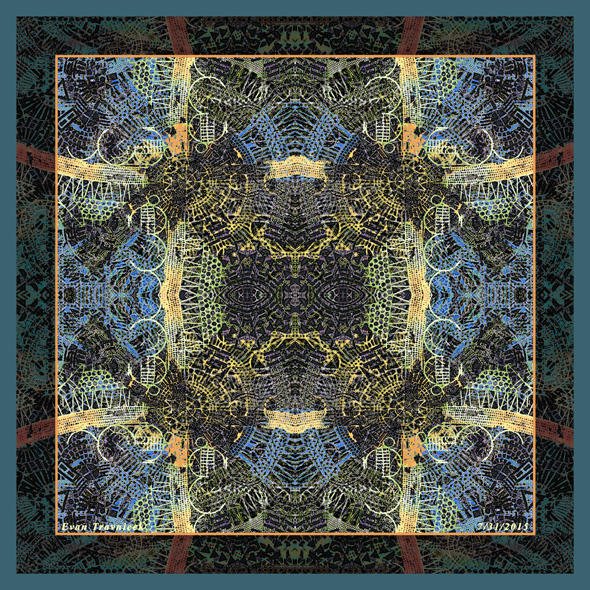
In a certain way, this image is like Pi squared squared. It should have a third and fourth dimension to it as well, but, alas! I can only produce various shades of light emitting from the flatscreen of your computer or handheld device in two dimensions. At least the frame surrounding the image gives you the illusion of depth as it recedes into darker shades.

I say Pi squared squared because the grid conjoining in the four equally proportionate sides—left, right, top, and bottom—look like Pi symbols on each side of the picture. If you don’t know what the Pi symbol looks like, then here it is: π. Now look at the image again, and see it in the orange and yellow grid formations. So there are four conjoined Pi symbols at right angles to one another.

I described to you in the last post the ancient Greek mathematician Archimedes’ Method of Exhaustion, and how polygons are used in increasing complexity to approximate Pi, as Pi is an irrational number that has an infinite amount of decimal places. There is indeed what looks like a semi-amorphous polygon (a square) in the center of the picture. The shape of it looks like it’s hinting at an eight pointed star as well. There’s that inchoate quality of pareidolia represented here again.

The materials I used to make this design were all derived from original hand drawn mosaics by myself. Primarily, it consists of two drawings—a new one called Without a Third Thought for which you have not seen yet, and another one I made a few years ago called Mandelic Mosaic. The combining of drawings and images from different sources by layering them creates new designs and more complexity. It’s the layering that creates the complexifying, shifting patterns that are so essential to bringing your mind to the edges of imagination.

Lately, I have noticed the trend in art of appropriation and collage making. I still don’t know what to make of all that; especially when more established artists take advantage of the pictures naive college students post on the internet and resell them as prints with only minuscular alterations. While I have used generic imagery from other sources on the internet for some of my art, I have also altered them enough so that they significantly differ from their original sources.

Having said that, I like to use my own material, and evolve it through successive designs and patterns. It’s like a process of framing a kaleidoscope at different points in its miasma of movement. Also, the layering of my own designs creates a sense of personal history through abstract imagery.

It looks like two mysterious and ancient ocular orifices are peering right at you in the center of this piece. It’s almost hypnotic, like you could sit and meditate in front of it and use it as a doorway for self-reflection. I hadn’t intended the effect of eyes, but within the process of situating the parts, pieces, and planes of the work, I synchronistically created them. I was pleased with that effect and honed in on it.

The title of this amalgamation is Drops of Rain and Shine in the Fabric of Time. It is one of my longer titles, but I felt it was appropriate as a poetic echo to give direction to your mind as to what it might represent. Of course you can have your own interpretations of what this work might mean to you. In fact, I encourage your imagination to take you wherever it leads while observing my art.

To me, it looks like drops of rain on the surface of a body of water; but it also looks cosmic, like the bridges, pathways, or fabric strands composing the yellow and orange grid  are streams of light and coronal ejections. Astrophysicists describe time and space as a sort of fabric, so I imagined time and space as resembling water. The circular formations inculcating the blue background give the impression of rings from raindrops in puddles of water.

The four main circular formations, or wheels, can also be seen as four supermassive black holes, or quasars, on the edges of our known universe; their emissions are the orange streams, and they connect with one another, forming a grid that allows the physical universe to exist as a fractalized hologram. Almost like a Cartesian plane, but in a much more complicated matrix than a simple square graph.

Leave a comment

July 31, 2015 · 8:13 pm

Fiducial Mechanics (version 4)

Fiducial Mechanics (version 4)

It takes a certain amount of trust to complete an action. Upon a whim, I’d recently researched the root words of the word “confidence.” People use this word all the time to explain something we all intuitively understand. Or do we really? I didn’t, because after realizing I had no idea what the root words were to construct a meaning from the word confidence, I really didn’t know what it meant.

I already knew the prefix “con” means with, or together. So I found that the root word “fid” comes from the Latin fidere, which means to trust, or to have faith. I realized, then, that confidence really means to have faith, or to trust in something together with that thing or person: to have faith together. Confidence now sounds like a religious conviction.

This makes sense to me, because even science can’t explain the nature of reality at its most elemental level still due to “quantum freakiness.” So what we have on our level of physical existence is really an unquestioning faith in something or someone because that person or thing has exhibited patterns that have been repeated countless times.

After further investigation into the Latin “fidere,” I found that it is used in another word called fiducial. Fiducial is often used in the financial field. It relates to trust funds and so forth. So there’s the root meaning of trust found in fiducial. It can also mean “reliable,” which is really just a synonym for trust and faith.

I thought that the title Fiducial Mechanics would be a good fit to give meaning to this image. Muscles, joints, mechanics and pivot points are expressed in this picture. It takes faith to move. That’s what I’m implying. How is it that acetylcoline transmits from your neuromuscular junctions? It all happens mostly in the unconscious bodily processes.

I theorize that matter really isn’t the dead, mechanical stuff that mainstream science still likes to portray it as. I believe that the whole universe is teaming with intelligence, even if it is so obscure, and hidden from the intelligences us humans have evolved so far in our own conscious developments. It took certain measurements of time to finally secure reliable movements and behaviors in the chemical processes our bodies perform, and these processes were accomplished by different forms of conscious awareness.

Leave a comment

June 9, 2014 · 7:07 am

Stories to Tell (catalog #130)

Stories to Tell (catalog #130)

The reason why this painting is along the lines of my Masks of Human Emotion theme is because this is what it often times looks like when the masks are taken off. Even in America’s liberal culture of expressing oneself freely, I’d say that people still have a multitude of masks given to them by the various institutions of our times. I suppose etiquette is one word that succinctly describes broad swaths of what I’m getting at here.

Etiquette is a sort of governing order that keeps groups of people in harmony and in line with the group’s interactivity. While individuals within the group may not agree with one another on one topic or another, everyone generally stays within the boundaries of what is socially acceptable to talk about and discuss. It’s usually a fear of criticism and rejection that keeps individuals within the boundaries of what a group’s social etiquette has delineated as an unwritten standard.

Large portions of a person’s character, identity, and creativity often get suppressed in the name of stability, harmony, and collective continuity, regardless of how rotten that collective state may be when heavily invested in groups. Groups range from kids who like the same music, to families attending a certain church, to political parties, all the way to extreme cult groups.

While groups, in themselves, aren’t necessarily harmful, they do require certain portions of human expression and emotion to be suppressed in favor of other expressions and emotions. If a person can detach from any sort of group with relative ease so as to reflect and express the suppressed feelings on one’s own, then all is well. The group can even be healthy.

It is when a group dominates, and takes over a person’s identity that the group becomes unhealthy in my opinion. What happens with the emotions, thoughts and feelings that don’t fit in with the group’s standards is that they become antithetical, not okay, and polarized into an unconscious state. They don’t go away either. In fact they build. Their energies are only allowed expression through the filters of a group’s standards.

This painting gives a visual description of a few of the underground emotions and feelings lurking behind the masks we have crafted for society, and that society has crafted for us. It is also reminiscent of when I used to be a landscaping supervisor at Loving Homes Greens in Riverside, California. I used to train and manage young men who elites would define as the lower classes of society. There was much drama involved in this, and many things were expressed out in the fields on hot Summer days that society normally suppresses in order to fit in and be pleasing to the managerial classes of society.

Leave a comment

June 7, 2014 · 7:28 pm

Plenipotent Firebrand (version 5)

Plenipotent Firebrand (version 4)

There are five different sources from which this image is derived. Two of those sources are my own hand drawn images, and the three others were images obtained from the internet. One of them is an image of vessels taken from a fluoroscopy, another one is a circular fiduciary marker, and the one you can see in the foreground–the blue and teal colored form–is actually a picture of the fire tornado that was recently seen in the California fires this year (2014).

I’d been considering how imprinting works in many different domains, physical, emotional, psychological, and spiritual. One comparison I’d recently read about is the type-writer ball. A type ball has the letters or characters of an alphabet on it, and spins accordingly to the correct character when a key is punched on the keyboard. That’s how typewriters from the 20th century were.

In many ways, people are like type characters in that they imprint the external world, and even their internal worlds, with their thoughts, feelings, actions, and energies. This image sort of looks like a type ball, or it can be compared to it at least. So many of the symbols represented in the selections combined in the creation of this picture seem to allude to an imprinted and imprinting soul.

The circle itself is a symbol of the self, as Carl Jung indicated in his research as a psychoanalyst. You can barely see the fiduciary marker coming through from the bottom layer here but it is basically the black and white colors you see coming through all the cracks . Fiduciary markers are used to mark locations in the body before a patient undergoes surgery for a certain procedure in his or her body, thus an imprinting is done to accomplish this.

The words I chose to title this piece indicate a character who has full authority to brand his or her world with fire. Branding with fire used to be done by ranchers in order to mark their cattle with a distinct character so as to distinguish one rancher’s cattle from another’s. I reversed the colors on the fire tornado–which you can see in the foreground on the lower right of this picture–so that the colors are different hues of blue. Normally, yellow, orange, and red are associated with fires, but natural gas can be blue when it’s emitted as a flame from a stove for example.

There is enough yellow and red anyway characterizing the picture that it easily communicates a sense of heat; a heat we are all experiencing this Spring and Summer.

1 Comment

June 5, 2014 · 7:19 am

No One’s Frenzy & the The Or @ician (version 1)

No One's Frenzy and The The Or @ician (version 1)

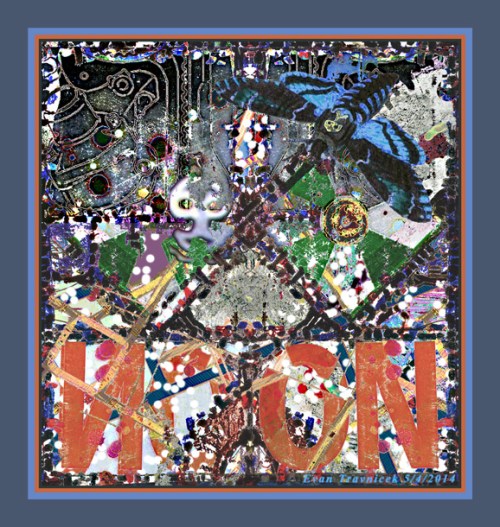
What we really have here is a play on words that got a little out of hand. You see, of course, the letters N-O-O-N at the bottom of this image, and they are undulated by and wound up in various entwining layers.

There’s a moth in the upper right that I used again for this particular series–the A series to my Wrecked Tangles (After the Crash) online art project. Briefly, After the Crash is intended to communicate foreknowledge of an impending crash in the global economy, and Wrecked Tangles is, yet, another play on words meaning to communicate “rectangles.”

So about the title to this piece… well, see, I was out downtown on Friday night, and when I left from walking around and talking to people, I got in my truck and thought of a different way of spelling “theoretician.” I broke apart the word into separate words, thus re-creating it into: The Or @ician. I really didn’t know what to do about the last six letters, as I couldn’t find a creative way to re-represent them.

“No One’s Frenzy” is a revision of “noon” for which you see at the bottom of this image. Noon can be reconstructed into no one. And the fact that there’s a moth dive bombing towards the capital letters at the bottom of the picture sort of conveys a moth-like frenzy at noon time. The image could really make a good piece for people to marvel and wonder over at a dive bar during the noon hour.

Leave a comment

May 5, 2014 · 8:35 am