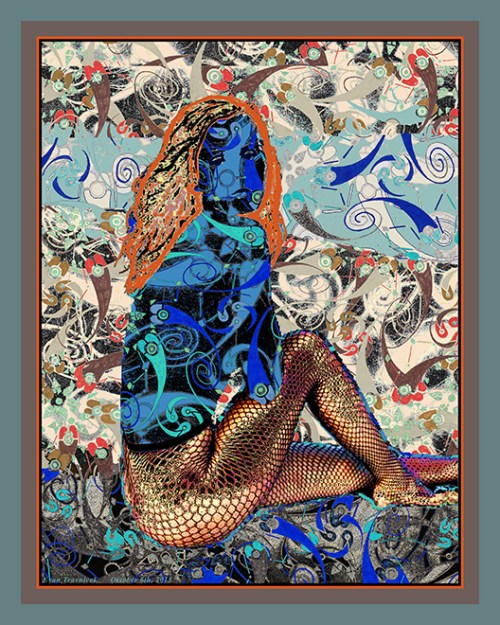
Wendy’s Sandy Waves (version 8)

wendyssandywaves8ematted

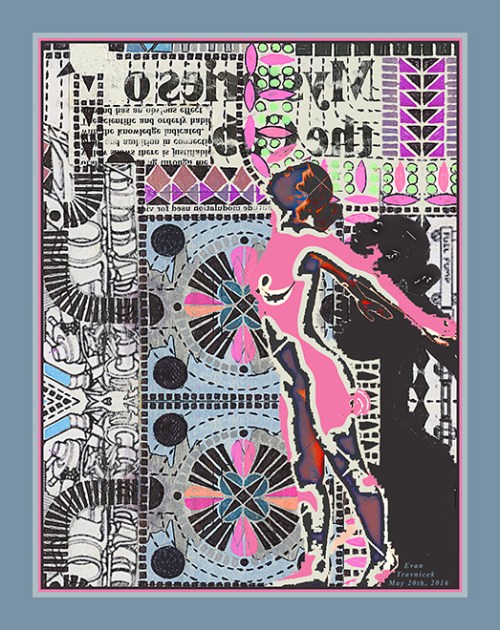
So you wanted to see some pop art in Art of eVan. Well, here is a piece with elements of it in it. I actually made this piece, and its variations, back in October 2015. It’s derived from a picture of a woman on a beach. The series is titled Wendy’s Sandy Waves. I thought of the figure as a mermaid bathing on a beach.

I thought of all the chaotic patterns as representative of uncontrollable emotions. Water is often depicted as a symbol for emotions because of their mercurial, ever changing qualities. The mermaid is taking a break from swimming around in them. She seems to be caught by you noticing her as she peers back.

The mermaid’s hair is what gave me the impression of pop art with this piece. It looks like some of Andy Warhol’s style of drawing over the hair of people in pictures he used for his silk-screen works. I rather think of this piece as more interesting than some of Andy Warhol’s portraits because the level of detail in the background is multiplied. The foreground, too, has much detail that satisfies me.

1 Comment

February 21, 2017 · 7:25 am

Developing to Save (version 1)

developingtosave1ematted

I needed to create another work of art to share with you. I hadn’t especially planned for this piece for any length of time. In fact, I produced it just tonight in one sitting. I already had the material to make it. I already have scanned in a lot of the drawings and collages I’ve been creating for the last few months, so I’m not lacking new material to work with digitally. I just haven’t posted much of my art lately to my profiles online.

I find the blogs I’ve posted previously with artworks intimidating because of the amount I’ve written for them. I’ve been at a loss for ideas in literal form lately because I’ve been developing a lot of visual ideas in my sketchbooks. So there’s been less writing on my part going on here.

One way I’ve found to help mobilize my writing talents is to record my dreams and write them down. Writing is an action. It’s more of an action than thinking, to be sure, but less of an action than carrying out the actions prescribed in the words. Actions, such as scribbling or writing, can stoke the imagination into finding new inspirations. But if one doesn’t do anything about the ideas that occur, then the ideas are as good as lost.

Some people have thought of art as not creative, but more like just rearranging matter and energy that already exists. My take on it is that, if time is removed from the equation, then an artist really is creating something. In timelessness, an artist is at the moment of conception in the universe, thus he or she is co-creating with the beginnings of what we might imagine to be our universe. Measurements of time may be relative, but timelessness is everywhere because it has no measurement.

I titled this piece Developing to Save, first of all, because of the text in the background collage work; second of all, for the activities I’ve been engaged with in my art lately. I mentioned that I’m developing a lot of ideas in my sketchbooks to use for further future developments. I have this habit however of not going back to previous ideas when I want to have an idea to work on. I have a strong urge to always be developing new ideas. It’s like I can never have enough new ideas to work with. I feel like an innovator. I can’t get stuck in a rut of one idiosyncratic dimension for the rest of my life.

A role model who has helped me understand this urge is David Bowie. I’ve micro-blogged before how he was constantly reinventing himself for the new trends that would arise around himself in the music industry, in culture, society, and art. I think he often juxtaposed himself with respect to whatever current trend there was and produced a lyrical and musical commentary on it. Art is about relationships, really, and Bowie was constantly readjusting himself with new identities in the continuum of change.

This piece, Developing to Save, is an attempt to deal with a contradiction. Developing implies a state of change, and save implies a state of fixation. The traditional visual arts—not counting motion picture or animation—are about the fixation of ideas into visual forms. The images produced in the visual arts are snapshots in time, space, energy, and the artist’s peculiar perceptions of his/herself and her/his world.

This image depicts the curved horizon of a landscape in my mind with odd shaped trees evenly spaced on the horizon. The green I imagine to be grass below the horizon. Yet, it’s like paint, or wallpaper, that was once applied to a wall, and it’s rubbing off now due to time, wear, and tear. The background is a selection of paper collage I assembled and glued together last year. I’ve used some of it in other works of art I posted to my Art of eVan blog.

Leave a comment

February 10, 2017 · 7:18 am

Mindy’s Blending Machine (version 2)

MindysBlendingMachines2ematted

In further explorations and experimentations with the female form, I combined this lady, whom I named Mindy, with a mosaic collage I’d drawn called Intraluminal Autoclaves. As you can see, the background collage is composed of textual material from old books and printouts of engine diagrams. I’m currently rather annoyed by the current rage of collage art. It’s a current trend with American arts and craft, scrapbooking hobby pursuits. I used to find it interesting, but because it has become mainstream and mundane, I’ve become bored of it.

Too many hobby artists today think they are being original with their collage scrap-booking art. They don’t even know who inspired them to begin with. They think they’ve come up with their ideas all on their own—like they just woke up one day, and started making collage art. I know that collage art, as I’ve learned from art history, comes from 20th century European art. Artists, such as Max Ernst and Kurt Schwitters, come to mind as a couple of original representatives of collage art.

Early collage art, dadaist, surrealist artists inspire me. They broke the mold of what art was supposed to be in their times and introduced a whole new way of making art. At this point in the 21st century, since collage art seems to have run its course of possibilities, I feel the commonness in this type of art now, though, paradoxically, I’m habituated with using it as a style in the development of my own art.

There are times when I am inspired by collage type art, but it has to be unusual, novel, and hybridized. Some artists pull it off really well. They have a great sense of streamlining unrelated biological and mechanical parts by putting them together to create new entities of expression.

I’m working out conflicts in my own creativity with respect to traditional art-making vs. the internet age and digital art; in regards to arts and crafts type art vs. unusual novel art; and of relating to my past freedom in making oversized mixed media oil paintings vs. the little detailed pen drawings I’m limited to creating now. I realize that Gary Bolyer, an online art marketing teacher, advises artists to not talk about themselves too much in their art blogging, but my developments are what I find most interesting in discussing. I suppose tensions such as these will always be there for me as an artist, and it’s probably good that they are. Dissatisfaction can be a good core driving motive for creating more artwork.

I titled this piece Mindy’s Blending Machine because it looks like a woman is walking in front of and through an industrial factory building. You can see cords, fans, and machinery behind her as she walks from the right of the image to the left. I altered the colors of her skin to dark and light pinks. This helps to blend her with the pink mosaic pieces behind her. An oversized shadow is also cast upon the wall below and behind her as if light were shining on her from her upper left anterior side.

The pink makes Mindy blend in with the background as if she where a chameleon. This is another idea of mine of a woman merging herself with her surroundings in order to extend her spirit out and create greater degrees of harmony. Maybe the pink beads coming from her mouth are utterances, like prayers, to the heavens beyond the machinery of materialism to fill her with love in order to share with the rest of the world.

The title, Mindy’s Blending Machines, has allusions to blenders that make smoothies. After drinking a strawberry smoothie, she feels the sweet satisfaction coating her inner sensations. I used the name Mindy because it has rhyming characteristics with the word blending. In art, it’s an advised practice to help blend and unify a picture by putting a certain color in foreground, as well as background, objects. This practice helps a picture harmonize better, even if the intent is to emphasize contrasting colors and boldness.

Leave a comment

January 18, 2017 · 4:08 am

The Enfeoffment of Hasenpfeffer (version 4)

theenfeoffmentofhasenpfeffer4

I like this idea of creating weathervanes, or mobiles out of wire. An artist I haven’t mentioned as an inspiration of mine—Alexander Calder—created mobiles out of metal and wire. He colored the vanes and panels at the ends of wires and rods bold colors. He was influenced by Joan Miro’s work, who, in turn, also filled in his broad, basic, abstract shapes with bold colors. And, yes, Miro is also an inspiration of mine.

In my imaginings of creating wire construct sculptures, I love the possibility of using the shadows they would cast on the ground as parts of the artwork. Like a disco ball for a dance floor, or a psychedelic animated projection playing behind a 60s rock band, I am fascinated by the employment of multi-media in art. But alas, my discouraged soul must plug away with jotting down these ideas in notebooks for now.

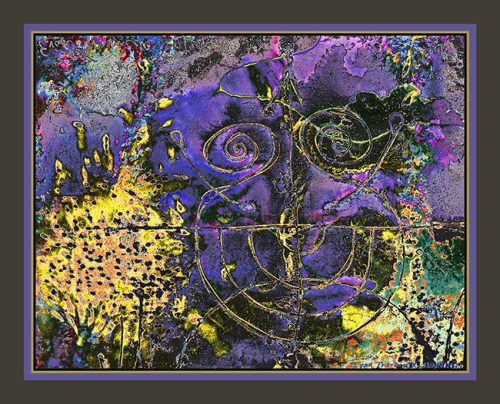
Here in this image, I am satisfied with the obtuse composition. What appears to be a burning bush off to the extreme left of the picture is a bold yellow form. Most of the rest of the picture is filled with purples and magentas. There is also a yellowish abstract manifestation showing up on the extreme lower right of the picture. The yellow from the bush and the yellow from the foliage off to the right are separated.

Bold colors, when separated like this on the picture plane, cause problems compositionally because they both vie for the viewer’s attention simultaneously and create a break in the flow of the eye’s path across the picture. The lines from the abstract wire construct create structured, organized pathways however, so that the eye can find a bridge with which to connect the overt disconnection. Moreover, I made the sure that the burning bush on the left was bigger and more dominant than the gallimaufry off to the lower right. This gives it a closer feel dimensionally to the viewer.

Some people have told me that this wire construct, reaching across and organizing the image’s visual properties, looks like a face, and perhaps there’s a hidden message in its symbology. I really was not intending any kind of covert message. I just have become fixated on drawing these basic wire construct designs. And, again, I’d like to, some day, make mobiles out of them.

Enfeoffment means the official deed by which a person was given land by a king under the feudal system of Europe of the Middle Ages in exchange for services. Hasenpfeffer is a dish made of rabbit meat. I learned of the word hasenpfeffer from watching a Bugs Bunny episode on the Loony Tunes cartoons. In that episode, Yosemite Sam is the cook for a king, and Bugs Bunny somehow becomes the target for Yosemite to make hasenpfeffer for the king. I suppose the face you may see in this image could associate with Bugs Bunny, or a rabbit, anyhow.

Really, the title of this piece could be re-worded as The Deed of a Rabbit. What would the deed of a rabbit be you may ask? We could ask Richard Adams, who wrote Watership Down, but he recently passed away. Watership Down is an adventure story about a group of rabbits forced to move off of their land, effectively becoming anthropomorphized animal refugees by land terraforming men. I highly recommend reading this book, as I found it to be extremely engaging when I was in middle school.

Rabbits are thought to be timid, easily scared creatures, but their powerful hind legs enable them to escape danger. But like Peter Rabbit, who liked to nibble on vegetables in farmers’ gardens, rabbits also have courage. They just are not ferocious beasts who scare other predators away. So I have an appreciation for rabbits as a symbol after reading Watership Down, and having the challenging experiences I had during my school years.

Leave a comment

January 1, 2017 · 6:45 am

Compressed Ontology (version 1)

compressedontology1ematted

A simple definition of ontology is “the branch of metaphysics dealing with the nature of being.” Since I learned of the word, I’ve always thought of it as the study of relationships of everything. Philosophically, it is confined to metaphysics however, which deals with the non-physical aspects of nature. Many twentieth century scientists, philosophers, and thinkers have relegated ontology to piles of superstition, folk lore, and hocus pocus however. This is because they believe physical matter is the final frontier in human exploration.

I use the word ontology in my title here as an artistic resource. To me, art has always been about relationships, and how anything relates to anything else. Complementary colors can be set side by side to one another in realistic or abstract depictions, such as red and green for example. These two colors create tension in the eye because of their contrasting relationship.

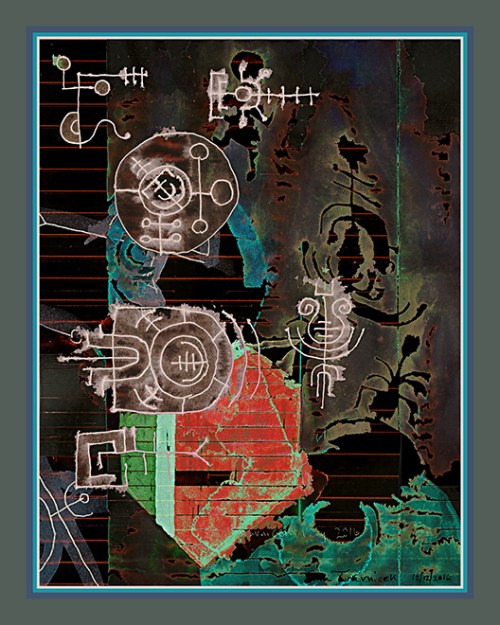
The main thing(s) that stands out to me that emphasizes the idea of relationships in this picture is/are the crude line drawings and the cubic object. I am drawn to the un-shaded cube. I intentionally drew the cube with Bic markers without shading. I like the effect that it has because, even though there is no shading, it still looks three dimensional. With the irregular teal colored pool next to, and in front of the cube, it makes it look like the cube is a melting chunk of ice. Hence, another ontological relationship.

I can get away with calling the relationships in this picture plane ontological because they really are not physical. In fact, this is a digital image you are viewing. If you invest in it as a limited edition (25) print from me, then perhaps you could call it physical. But even then, the objects in this image are not physical. They are mere representations of symbols I made up, and which I put no effort in defining. I just like to create simple wire constructs as drawings because of the structures and spaces they excite for me.

Art allows me to express myself in ways that words would be forbidden. Art is my Freudian slip. Art and music have always been vehicles in various cultures, societies, and civilizations as valves that allow for the release of whatever is suppressed in those worlds. I learned that ancient Egyptians, for example, had layers of meaning hidden in their hieroglyphic language. Painters of kings and queens in Medieval and Renaissance Europe frequently subtly betrayed their masters by infusing barely noticeable symbols or expressions indicating questionability of the tyrant’s power.

In my own art, I have full freedom to play with the tensions between objects, subjects, and colors without offending anyone. Abstract art allows for the full expression of one’s soul because it’s not recognizable in standardized ways. Or, the shapes are so universal—squares or circles for example—that their symbolism can mean too many things to be sure they mean one thing only.

I thought Compressed Ontology would be a good title because of what it means to me. Decades ago, I read a trilogy by Robert Monroe concerning his out-of-body experiences. He discovered in his nightly journeys that he possessed a “second body,” an immaterial body, that he was able to detach from his physical form and then explore the universe, physical and non-physical. In one of his journeys, he described physical life for humans as an artificial “compressed learning” environment.

I thought about what compression means in this regard since reading those books. Compression would mean a rather forced, limited environment in which resources are scarce and physical beings must deal with one another, for better or for worse. I suppose the learning part of this compressed environment we all live in comes about in time as we “successfully” deal with situations minute by minute, hour by hour, day by day, person by person, etc., etc.

Most people I would venture to say have been born into less than optimal environments in which stereotypical “success” is out-of-reach, thus securing a situation for the soul in which certain people and circumstances are compressed, and “forced” upon the soul seeking spiritual growth in one way or another.

The floating, abstract, crude, wiry objects floating above the ground have a sense of heat about them, indicating “hot to handle.” They sort of remind me of the wire loops surgeons use for loop electrosurgical excision procedures (LEEP). They also remind me of the iron brands farmers use to mark their cattle’s skin for recognition. Fiducial markers are other objects used for landmarks or locators associated with this idea. So we have hot and cold sensations coming from this picture: The colorful, melting ice cube, and the hot wire constructs.


5 Comments

December 26, 2016 · 6:22 am

Provincial Dumbshits (version 3)

provencialdumbshits3ematted

I was trying to figure out what to title this piece for a while. I knew what the idea was based on with the original drawing. In visual art, there are lines and colors that define things in the picture plane. In real life, objects, people, and animals are defined by their forms and boundaries. Humans have created the concept of owning property. Properties are legally defined by boundaries. In a more abstract sense, properties can also be allotted to things like chemical structures. So salt, for example, has salty properties that you can taste. Propriety is a word that characterizes a person’s sense of etiquette and social intelligence in social spheres. Propriety is a set of behaviors that one “owns” and exhibits to others to achieve unwritten and written credentials of acceptance.

I applied crudely aligned lines and colors in the original drawing for this series to highlight to you the questionability of boundaries. Most people are insecure about themselves and their properties, so worlds of “defense” and attack are maintained to manage the tensions peoples’ insecurities create. One approach to questioning the temporal, mortal, mutable boundaries people try to maintain is by showing, through science, the vast spaces that exist between planets; or, taking it down to atomic levels, showing people the boggling spaces that exist between subatomic particles, which is basically like scaling down interplanetary models; and finally showing how particles themselves are immaterial subatomic bundles of energy.

For the last couple of years or so, I have been exploring depictions of clutter. In contrast, historical Asian artists—especially Zen artists—have shown their mastery of using space for senses of fulfillment in their art. In my art, I feel like this is a state I am working towards, but in the meanwhile, I’m exploring various states of clutter. So, this piece here is a state along that journey. Yet, it has more space in it than other works I’ve done. The spaces also exhibit properties of variation in ambient color and etherial qualities.

A comment was recently made on my Art of eVan pan fage implying that some people think that “even a three year old kid could draw that.” It’s an amusing stereotypical remark abstract artists have encountered since abstract art proliferated in the early 20th century. I wouldn’t be surprised if the French Impressionists encountered comments like that from the provincial dumbshits of their time. And that’s what I titled this piece: Provincial Dumbshits. It’s a blunt comment right back to those who make it. Perhaps reactionary, but oh well, this is my art and my blog.

I used to live on a retired farm with my family in Eastern Nebraska for several years. I got to know the community there to a certain extent. Having moved there from Southern California in 2000, I thought I would take the Midwest by storm with my revolutionary art. I learned over time that this was not going to happen. Looking back, my art really isn’t that revolutionary in terms of mediums used. I suppose it could have been had I pursued digital animation more. I had a few ideas I was working on when I was attending school at Metropolitan Community College in Elkhorn, Nebraska, that could have been developed further.

Every once in a while, farmers would come and visit our family. We were renting out our land to other farmers in the community to farm, so they would store their equipment in my grandparents’ tractor sheds. Sometimes I’d show them my art—my big paintings—and I could tell it got reactions. My art is just so weird, abstract, and surreal to their weltanschauung that it sort of alienated me. Most farmers have nice, soft, pastel, kitschy landscape or still life scenes as “art” in their homes.

I talked to one of my dad’s cousins about the way of life in rural Midwest, and she explained to me that most people in the farmlands have a “provincial” outlook on life. They haven’t been to any big cities, other than Omaha or Lincoln. Their entire lives are spent in small town and farm community affairs. So they literally have no experience dealing with other places and peoples. I understood. But I gained a sense of love and respect for the Midwest over time. After all, I was born in Lincoln.

When I title this piece Provincial Dumbshits, I do it with love, but also a jab of edge. I suppose it’s an expression of frustration with the human tendency, in general, to cling to world views and belief systems, no matter how limited or wrong they may be. Not only do people in the country have this tendency, but people in the cities have this tendency as well. And so there is another contrast that creates an invisible boundary between country and city folk.

In summary, this piece, with its broken lines sparsely scattered about, symbolically questions all these temporary boundaries we all erect physically and psychologically to defend ourselves from others, the rest of the world, and the universe. Meanwhile, since we’re mortal, and earth itself is constantly changing, heeding not one wit to our borders and boundaries, none of these things we create to define ourselves and our universe will last forever. The spaces and ambience underlying the lines defy their crude claims, symbolizing the anxiety we all feel in our unconscious minds as we live day to day meeting our survival and reproductive needs.

Leave a comment

December 23, 2016 · 9:55 pm

Astonished Buoyancy (version 1)

astonishedbouyancy1ematted

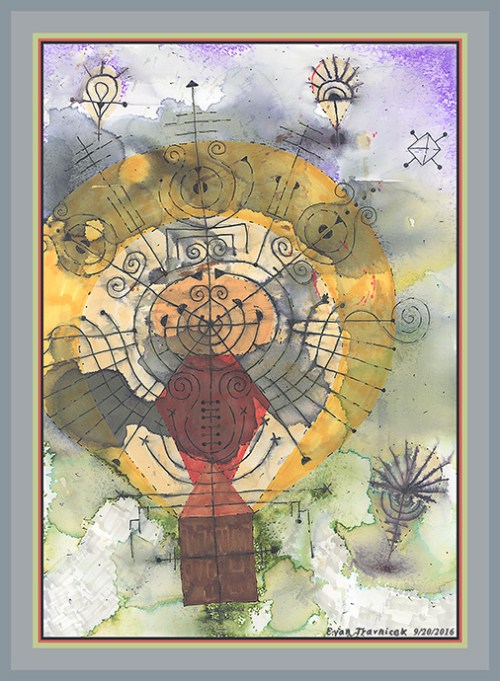
I drew this piece this last Summer. At the end of Summer. The Balloon Fiesta here in Albuquerque lasts from October 1st to the 9th however. The shapes here in my image are balloon shaped, and the background looks like borderline psychedelic clouds.

I have been thinking of my art as non-political lately. I used to make paintings that were quite in depth with symbolism and personal symbolism. I’m sure many of those paintings could be interpreted in political ways. However, way back when I first started seriously painting, I had NO interest in politics.

They are balloons with bones, or structures, in them; like kites have sticks to give them stability and structure. I found some similarities of this drawing to Odilon Redon’s work. He drew and painted cyclops type balloons and characters. Some of his most famous artworks include these strange symbols. While drawing this image, I wasn’t thinking about eyeballs however. I was thinking about the bulbous shape that standard balloons take.

In other drawings I use this shape as petal formations encircling the floral disc. There’s a term I learned a couple of years ago called “splanchnic.” It’s a scientific term for guts. As it applies to the orange fruit, splanchnic are those little bulbous formations containing nectar and juice inside the slices. I think of these balloon like formations as splanchnic.

Taking journeys upward, being lighter than air, are what balloons are built for. I remember seeing some fictional depictions of what could possibly be lifeforms on Jupiter in Carl Sagan’s Cosmos. He called these lifeforms “floaters” because they were designed—or perhaps evolved—to float in the gaseous clouds of Jupiter. This idea always fascinated me. It opened my mind up to what alien lifeforms might look like.

Anyway, what I’m doing with my current drawings is making the viewer look at basic lines, dots, and shapes. I add subtle layers by washing the pieces with water or acetone to distort and bleed the shapes and lines. The continuous spaces that water creates with the colors allows for new dimensions to be penetrated. Instead of being totally two dimensional, the drawings end up flooding into new, unexpected, characterized world fulfillments.

The spaces between the lines are intended to capture mood, memory, association, and projection for the viewer. The spaces allow the mind to wander. The surrounding structures allow for stability.

2 Comments

December 15, 2016 · 9:26 am

Bower of Briar (version 1)

bowerofbriar1ematted

When finishing up a new work of art, my mind often draws nothing I would consider witty and poetic when I try to complete it with a title. Yesterday, I was streaming my consciousness, and jotted down a few thoughts and titles with respect to this piece. One of them was “Matchsticks for a Gas Stove.” While I have been micro-blogging my conflict with respect to climate change science lately, I just didn’t want to associate this piece with politics.

My art is an escape from politics. It’s a place of magic, wonder, exploration, experimentation, fun, mystery, intrigue, fantasy, poetry, and imagination. Politics has a tendency to destroy all that for me. So I compartmentalize my intellectual and creative pursuits. The title, Matchsticks for a Gas Stove, would have had too much suggestion of careless human CO2 production as narrated by Washington’s cadre of left-leaning politicians, lobbyists, lawyers, and journalists. Please understand that I’m not an anti-leftist. I just have been disappointed by the left’s tendency to favor big banks and illegal wars over the working classes in the last several years.

With my art, I really want to escape, or at least transcend, the confining roles of left vs right politics. I know that George Orwell wrote that “all art is propaganda” last century, but I still want to transcend that perception. I figure that left vs right politics, as a gestalt, or greater whole, holds itself in check, and rocks back and forth like a pendulum over time. This enables me to let go of insecure needs to insert left or right pieces of information for public consumption on social media.

In finally reaching the other side of this bridge over political waters, I found a satisfactory part of my life to write about and share with you associated with my new image. A few years ago, I was dating someone who really opened my heart up in a way that I’ve NEVER in my whole life experienced before. I had decided to break up with her because I already knew what the outcome between us would be. I had lost a job I had back then and I had to move back in with family. These factors significantly insecuritized me and I knew that I would be betrayed in some way, so I cut things off.

I haven’t dated anyone for the last few years. I have had experiences, but I just pretty much avoid relationships now. Compared to the average person, it is like ten times a challenge for me to open up, trust, and love another person. Most people, I find, to be mostly self-serving, and often in ways I find treacherous and untrustworthy. This includes the woman I started to fall in love with. I forgive her however. Nonetheless, I have not and will not pursue any kind of friendship with her, not out of spite, but in order to protect myself from being hurt.

What I want to describe in reference to this image I’m posting here is the sense that the woman I was with did something permanent for my heart. She opened up a new dimension of love for me that, as I already mentioned, I had never experienced before. It’s like she spiritually infused an added quality of love into the locked away parts of my heart since I was a child. Perhaps she added nothing, and my heart was ready to open up to a new dimension when I was with her to start with.

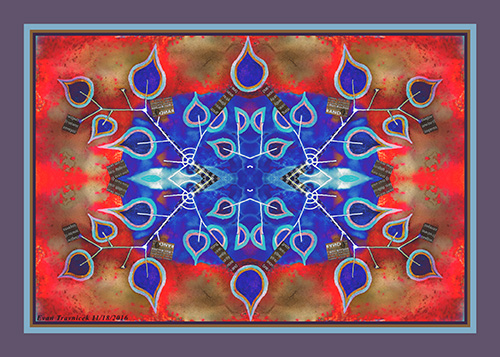
Anyway, this image looks, to me, like two different kinds of heat: Red inferno surrounding emissions of blue flames. The twigs with leaf-like formations on their ends can be perceived as matchsticks, thus giving the impression of using matches to help a gas stove light up. Blue flame is considered a more pure form of heat that won’t blacken pots and pans when its flame seers them. Symbolically, the blue center represents the places inside me that have been replaced with purer forms of love as they grow and expand further—tentatively at times—outward into the world of raging, lusty, careless, media / dust storms.

2 Comments

November 20, 2016 · 7:01 am

November Golden Leaf (version 1)

novembergoldenleaf1ematted

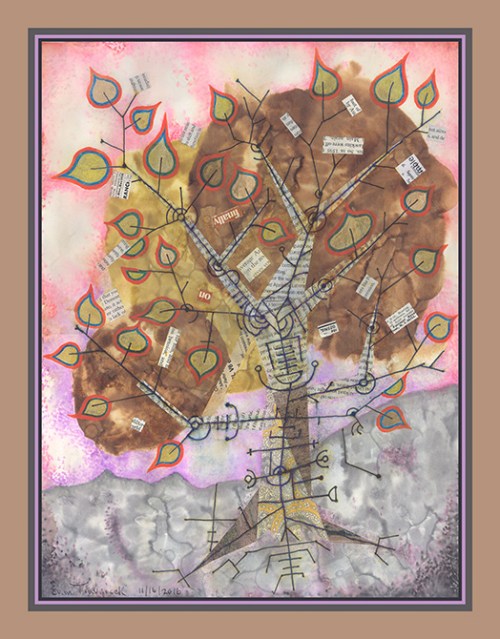
Just the other day, I got a couple new Schneider pens at the UNM bookstore. Schneider makes pens that are not totally water resistant, and that’s what I want for the mixed media drawings I’ve been making lately, and have made in the past. Pilot and Pentel are also brands that make water susceptible inks in some of their pens, so I use them as well. The particular Schneider pen I used for this drawing has slight colors of blue and yellow when it bleeds under the influence of water.

For the background colors of this drawing, I used alcohol based markers. Those colors can be seen in the bodies of the foliage for the tree, and also for the landscape for which the tree is rooted in. I splashed rubbing alcohol on these so as to wash, bleed, and blur it. The trunk and branches of the tree are made from the printed on pulp of paper media, such as magazines and books.

A guiding principle I consciously employed in the making of this image I learned from reading Robert Henri’s The Art Spirit manuscript. He emphasizes in his book that an artist should cover the plane with broad, basic shapes in order to furnish the soon to be picture with a structure upon which to add more detail. In reading Benedict Spinoza’s philosophical work on sharpening one’s wit, he suggests that a person’s reasoning abilities should start out with basic concepts and then progress into more complexity. This is much how civilization seems to develop, from the stone age up to now, the information age; at least Western civilization, that is.

I sometimes get bored and irritated with basic shapes in my art studies, but there’s no way around it. Everything in art starts out with the most basic, simplistic designs imaginable. These shapes then build upon one another as I imagine and act on developing a work of art further.

To skeletonize the tree, I drew black lines from my Schneider pen on the trunks and branches after the glue soaked cutout material dried on the surface. Using the pointillist technique, I dotted the sky with peach and lavender colors, and also the land below with grays. The middles of the leaves I carefully drew on the twigs of the tree are filled in with gold gel pen ink. I surrounded them then with a sky-blue ball point pen ink, and this is encapsulated by orange acrylic paint for which I painted with a brush.

The story is the colors and the season we are currently in—Autumn. I imagined a tree family called November Golden Leaf. This tree’s leaves literally turn gold in the Fall.

Leave a comment

November 18, 2016 · 6:32 am

Ghosts of Flower Bones (version 1)

ghostsofflowerbones1ematted

Here is an expression—a culmination—of what I really love in life. I’ve been working at a very condescending, obstructive, and incompetent environment for the last three months, and I was recently let go. Normally, I would have felt rejected, and sorry for myself, but this time I felt a sense of peace and freedom I haven’t felt for a long time. I had been working on this mixed media drawing in the last couple of weeks up to the point at which I was let go from this recent job. I finally finished it the day after I was let go.

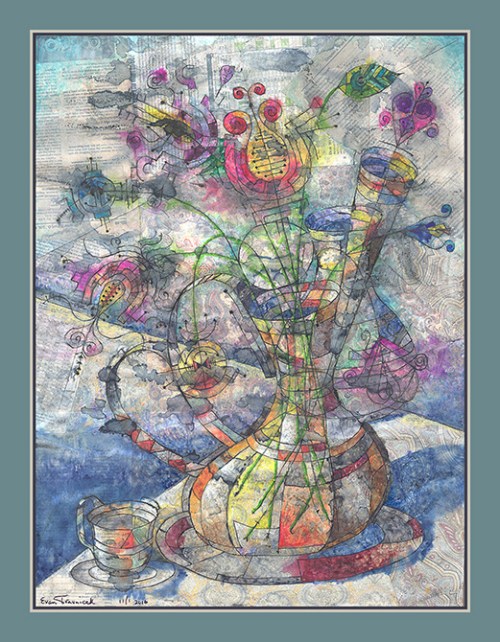
This drawing is a culmination of so many ideas and artists who have inspired me: Paul Klee, Maria Elena Vieira Da Silva, Paul Cezanne, Van Gogh, and many others. Da Silva and Klee have such unique and individual ways of expressing the line in art that their obsession was passed on to me. I love the idea of objects being translucent in a spiritual sense and my senses being able to perceive and imbibe the multiple layers that they stack around me.

Cezanne was known as the progenitor of Cubism, though he did not invent cubism. It was Pablo Picasso and Georges Braque who officially developed scientific cubism. Nonetheless, when one looks at Cezanne’s still lifes, one can see the odd angles at which the different objects in the scenes are depicted. This is a distorted sense that I wanted to emulate here in this drawing and take it on a journey of my own efforts. Perhaps Van Gogh’s sense of color and swirls can be picked up here as well.

I used different papers and pages from old books pasted together as the preparation background on which I would draw this drawing. I made sure that the text, patterns, and pictures from the collage work did not show too boldly by washing it with diluted primer and acrylic paint. For the black lines—which I see as skeletal structures for the flowers, vases, and tea cup—I used an ink pen that bleeds under the influence of water.

For a lot of the spaces that I colored in, I used Sharpie markers. Then, to give the sharpie colors a washed-out watercolor effect, I used acetone as a wash flung over it, and brushed over the picture plane. I touched things up with more highlights and colors by using dry and oil pastels.

This picture really looks to me quite dimensional with depth. It is a quality I’ve noted in previous paintings I’ve done in the past. Depth and dimension seem to be things I don’t really have to struggle with creating. It comes naturally. Anyway, I hope you enjoy this piece. I haven’t posted any new artwork for a few months now. It’s because, again, I was working at a miserable job with very unhappy people. Now that my emotional energy is free of that toxic environment, I will be posting my art more often now.

1 Comment

November 7, 2016 · 3:55 am