
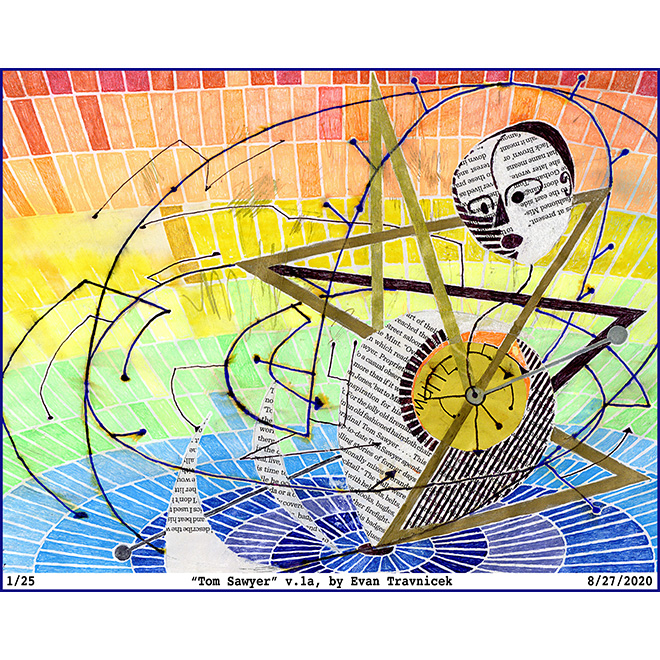
The art of sheer randomness and utter whim is actually not that haphazard. This image is based on a mixed media drawing I finished up in August, 2020. I manipulated the hell out of it in Photoshop, and this is the closest image to what the original looks like with regard to the colors and composition. To make the drawing, I used a design I’d previously drawn as a template for a manual, handcrafted, oil transfer print on to another surface of paper. The background noise in the space is intentional. I rely on its randomness and unconsciousness to express movements in an illusory space from the pressure of my hands as they work to draw whatever design I want to transfer.
Please note that this new blog post is a repeat of my past blogpost, Tom Sawyer (version 10). I repeated it here because I needed some blog content to go along with the new post. I just upgraded my WordPress page to a premium account for freelancers, and I want to post something new on it so I can insert the new payments feature I now offer on my website for people to purchase prints, like this one from me…
Theory of Mind research shows us that the unconscious mind is 30,000 times more powerful than the conscious mind. This is why the phenomenon of resistance to change seems to be so universal to humankind. Surrealist artists hoped to express contents and elements of the unconscious mind through their art and poetry mostly using dream imagery and symbolism.
I take the unconscious mind to another level of expression. Of course it’s based on Paul Klee’s work and main method of creating art—the oil transfer technique—but the level I take it to is the work I do in Photoshop which allows me to use filters that that emphasize, alter, highlight, and distinguish elements and effects in my art that would otherwise be mostly hidden. In effect, I’m making the invisible visible. I emphasize ambience, space, and unnoticed particles and entities.
When he was still with us on earth, Art Bell used to have ghost hunting experts on his show for interviews. The ones I listened to explained that they used recording equipment in abandoned locations that were said to be haunted. They wanted to see what kind of possible ghostly, intelligent, semi-comprehensible, audible information they could pick up with their equipment. I like to think of my art making as a process similar to EVP recordings in spirit.
The German philosopher Immanuel Kant wrote a classic volume of philosophy called The Critique of Pure Reason. I was lead to look at this book because of a really cool book I’d read several years ago called Art Theory For Beginners. I recommend anyone interested in the thought processes behind Western art to read that book for a much better understanding of Western art. It’s not in depth, but it touches on so many philosophical and historical understandings of great art and the time periods it was made in.
Kant questions what is a thing in itself? Can we really know what a thing is without the biases, and finite perceptions of our localized, politicized brains? Hence, abstract art seems to be becoming more interesting to people. So the title to this piece is Chalked Up Tchotchke. Yes, I saw that word tchotchke recently on my Twitter feed. It basically means something that’s more decorative rather than functional.
Price for an unmatted print is: $90.00
 Art of eVan