
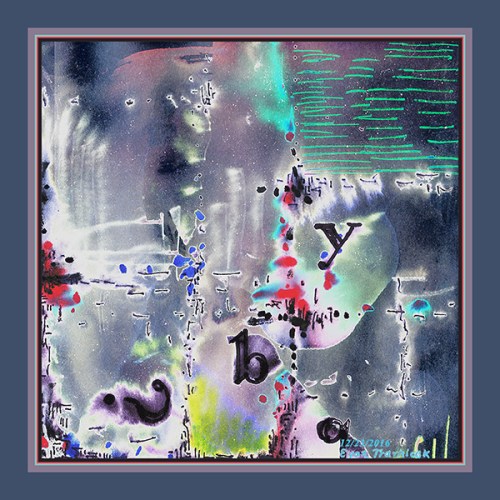
I was trying to figure out what to title this piece for a while. I knew what the idea was based on with the original drawing. In visual art, there are lines and colors that define things in the picture plane. In real life, objects, people, and animals are defined by their forms and boundaries. Humans have created the concept of owning property. Properties are legally defined by boundaries. In a more abstract sense, properties can also be allotted to things like chemical structures. So salt, for example, has salty properties that you can taste. Propriety is a word that characterizes a person’s sense of etiquette and social intelligence in social spheres. Propriety is a set of behaviors that one “owns” and exhibits to others to achieve unwritten and written credentials of acceptance.
I applied crudely aligned lines and colors in the original drawing for this series to highlight to you the questionability of boundaries. Most people are insecure about themselves and their properties, so worlds of “defense” and attack are maintained to manage the tensions peoples’ insecurities create. One approach to questioning the temporal, mortal, mutable boundaries people try to maintain is by showing, through science, the vast spaces that exist between planets; or, taking it down to atomic levels, showing people the boggling spaces that exist between subatomic particles, which is basically like scaling down interplanetary models; and finally showing how particles themselves are immaterial subatomic bundles of energy.
For the last couple of years or so, I have been exploring depictions of clutter. In contrast, historical Asian artists—especially Zen artists—have shown their mastery of using space for senses of fulfillment in their art. In my art, I feel like this is a state I am working towards, but in the meanwhile, I’m exploring various states of clutter. So, this piece here is a state along that journey. Yet, it has more space in it than other works I’ve done. The spaces also exhibit properties of variation in ambient color and etherial qualities.
A comment was recently made on my Art of eVan pan fage implying that some people think that “even a three year old kid could draw that.” It’s an amusing stereotypical remark abstract artists have encountered since abstract art proliferated in the early 20th century. I wouldn’t be surprised if the French Impressionists encountered comments like that from the provincial dumbshits of their time. And that’s what I titled this piece: Provincial Dumbshits. It’s a blunt comment right back to those who make it. Perhaps reactionary, but oh well, this is my art and my blog.
I used to live on a retired farm with my family in Eastern Nebraska for several years. I got to know the community there to a certain extent. Having moved there from Southern California in 2000, I thought I would take the Midwest by storm with my revolutionary art. I learned over time that this was not going to happen. Looking back, my art really isn’t that revolutionary in terms of mediums used. I suppose it could have been had I pursued digital animation more. I had a few ideas I was working on when I was attending school at Metropolitan Community College in Elkhorn, Nebraska, that could have been developed further.
Every once in a while, farmers would come and visit our family. We were renting out our land to other farmers in the community to farm, so they would store their equipment in my grandparents’ tractor sheds. Sometimes I’d show them my art—my big paintings—and I could tell it got reactions. My art is just so weird, abstract, and surreal to their weltanschauung that it sort of alienated me. Most farmers have nice, soft, pastel, kitschy landscape or still life scenes as “art” in their homes.
I talked to one of my dad’s cousins about the way of life in rural Midwest, and she explained to me that most people in the farmlands have a “provincial” outlook on life. They haven’t been to any big cities, other than Omaha or Lincoln. Their entire lives are spent in small town and farm community affairs. So they literally have no experience dealing with other places and peoples. I understood. But I gained a sense of love and respect for the Midwest over time. After all, I was born in Lincoln.
When I title this piece Provincial Dumbshits, I do it with love, but also a jab of edge. I suppose it’s an expression of frustration with the human tendency, in general, to cling to world views and belief systems, no matter how limited or wrong they may be. Not only do people in the country have this tendency, but people in the cities have this tendency as well. And so there is another contrast that creates an invisible boundary between country and city folk.
In summary, this piece, with its broken lines sparsely scattered about, symbolically questions all these temporary boundaries we all erect physically and psychologically to defend ourselves from others, the rest of the world, and the universe. Meanwhile, since we’re mortal, and earth itself is constantly changing, heeding not one wit to our borders and boundaries, none of these things we create to define ourselves and our universe will last forever. The spaces and ambience underlying the lines defy their crude claims, symbolizing the anxiety we all feel in our unconscious minds as we live day to day meeting our survival and reproductive needs.
 Art of eVan