
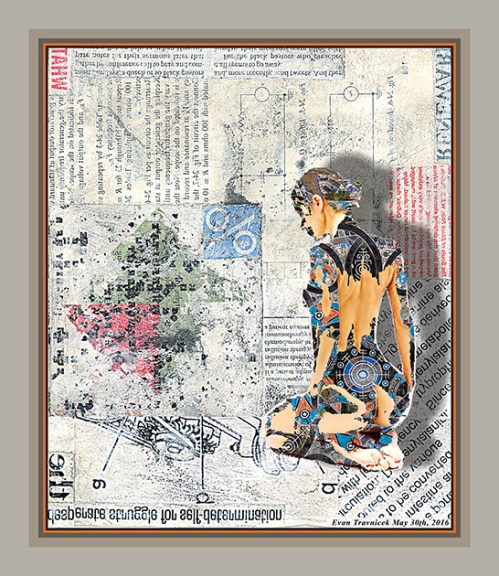
One of the latest cultural rages is to have tattoos all over your body. I’ve noticed this trend increasingly over the last several years. Up in Nebraska, people are mostly conservative, so I didn’t see too many folk with tattoos all over their bodies when I lived there. I suppose more people had tattoos in the inner city of Omaha however. I bet this trend has increased there, too.
Here in Albuquerque, I see so many people with tattoos. Just workers in restaurants and super warehouse stores. I suppose people in the higher echelons of business and corruption just cover up their tattoos with long sleeve button-ups and ties. Is this ghetto? I’m rather proud of myself for not having a single tattoo on my body. It’s a symbol—or absence of a symbol—of my stubborn independence and to not give in to peer pressure. Yes, peer pressure continues on after high-school and college. It just upgrades to cars, lawns, bodies, wives, husbands, kids, and cell-phones. The fun of never having enough never stops.
I believe the fetish with having tattoos stems from the general aversive American attitude towards touching people, other than loved ones and relatives. I believe the ritual of getting a tattoo creates a very impressive—and painful—memory on one’s body. To me, it’s sort of a destructive activity, but that’s just my opinion. I know that tribes of cultures, not engaged in the obsession with worshiping technology, use tattoos for religious purposes. I haven’t researched those purposes to any degree, so I can’t expound on that right now.
I’m just noting the trend with tattoos. I’m also linking that trend with this new work of mine. Sophia, the name for the model I used in this piece, looks like she has large areas of tattoos on her integumentary system. The pattern of this tattoo is Meme Catcher, an altered illustration of mine that I blogged about at the end of 2015. In Gnosticism, Sophia was the syzygy of Christ. In other words she was the feminine expression of Christ.
Sophia is a Greek name, which means wisdom. Wisdom is connected with knowledge, but I’m not sure if they mean exactly the same thing. When it comes to non-physical terms, such as intelligence, knowledge, and wisdom, it becomes much more difficult to define and separate the terms so that they are understood in isolated and individual ways.
The tattoo on Sophia’s body looks like it has depth to it—like it looks like you are peering into another dimension—and the frame of Sophia’s body is the doorway as her skin peels away in a metaphysical apoptosis in her meditative physically unbinding state. She is sitting in a meditative posture I learned in Karate called Seiza. It is a posture from which a person can get up easier than from a full lotus meditative posture. Karate, by the way, is another activity Americans engage in as a hobby, which—not surprising to me—involves contact and touching other people.
In this image, however, the model is alone. She sits alone. While being alone isn’t necessarily necessary in order to meditate, it does create a state conducive to more intimate contact with the universe, God, one’s higher self, or whatever however. I put a drop shadow to the right of Sophia giving the contents past her body a sense of depth as if they were on a wall.
On the lower left hand of the picture are the words are “desperate struggle for self-determination.” I like the chasm your imagination engages in to find connection between a young woman meditating and whatever image you get for a “desperate struggle for self-determination.” The way I interpret that is that decision-making truly lies within oneself, and is acted on by oneself and oneself alone. Hence, the singular meditative figure.
 Art of eVan