
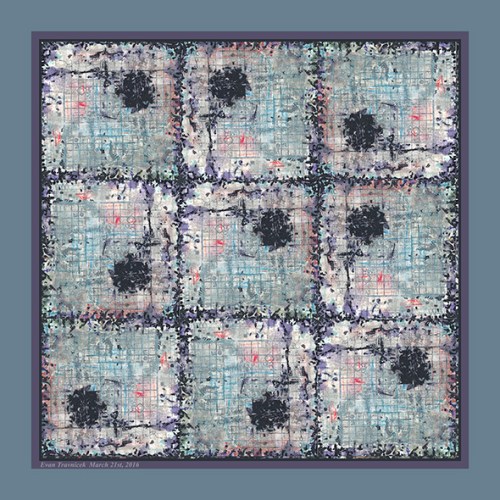
They look like wrinkles in the sheets of a bed. They look like nine square beds fit closely together for storage, creating a plane of mattresses and sheets; like fields of farms below an airplane as you travel overhead. Of course I hadn’t thought of this perception while I was drawing the original piece on collaged paper, which is derived from After the Crash J1 for which I posted previous to this one.
I selected this area of that drawing and repeated it eight more times, thus creating nine cells for which you see here. I turned each cell however so that each adjacent cell is not identically positioned, thus rendering a random—what looks to be—coded image.
It looks like the black cloudy spots in each cell could be nuclei for biological cells, and the surrounding speckles on the borders of each cell are the membranes. There are skin cells in the human body called cuboidal cells. I liken these abstractions to them.
Having made two comparisons already—cells and beds—I note to you that skin cells on the epidermis of your body are rubbed off each night on the sheets of your bed. The colorful impressions of your dreams are added to the folds of your soft sleepfulness as well. But you turn every once in a while to reposition your body in a more comfortable position while you sleep, like the Andy Warhol film called Sleep.
In my healthcare statistics class, I calculated simple formulas for hypothetical bed counts in hospitals. That’s part of the reason why I titled this piece bed count. When a hospital is a maximum capacity, all the beds are used leaving no more beds for new arrivals. That’s why an exact bed count is so important for healthcare workers to know working in a hospital. If there are less patients than there are beds, they can be calculated in ratios.
I don’t know if you can see the salt crystals mingled with the blue areas, but there is indeed salt that I used on the original drawing. I did this to create clouding and bleeding effects. I also used rubbing alcohol, which I splashed on the nervously applied random dots speckling the borders and the spots. You can see the bleeding effect in some of these areas creating an off purple color.
 Art of eVan