
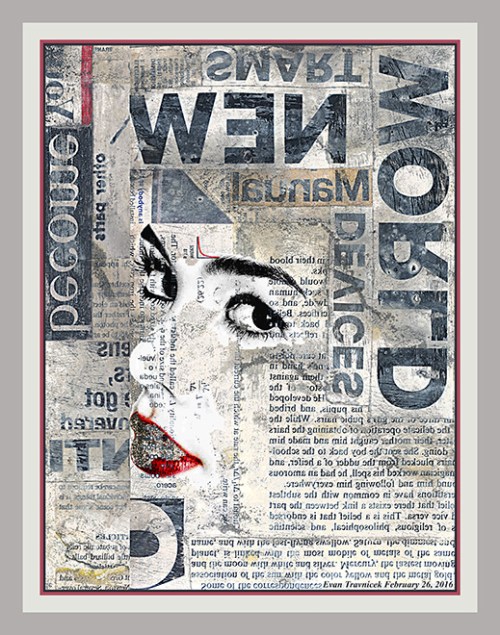
The media used for this piece is nothing new to art. Collages and assemblages have been used by artists since the early twentieth century. There may even be instances before the 20th century as well where craftspeople used readymade printed on paper and objects to construct images or sculptures. The shifting paradigms around art in the 20th century, however, allowed for collages and assemblages to be conceived for acceptance to wider appeal.
Moreover, the techniques I used to give this piece it’s weathered and scraped look is nothing new to art. In fact, the distressed technique in the kitsch and decorative arts have been well established for a number of years now. So I don’t necessarily feel that original in this way with regard to this piece.
I suppose one thing that comes to mind is the reversal of the text so that it semi-illegibly hints at something a little more original, but even that technique is well-worn by many artists. I do, however, enjoy the subliminal, creative, and suggestive aspects of mixing words and letters up. This technique, of course, originates from William S. Burroughs, an author from, again, the 20th century.
In my review of assemblages and collages, the artists I can think of right now who were the originators of them are Robert Rauschenberg, Kurt Schwitters, Max Ernst, and many other Dadaists and surrealists. I suppose my fascination with these art forms is found in their recyclable qualities, and their suggestions to re-use found objects & periodicals for irrational reasons. I’m repelled and drawn to these modern day kitsch, arts & crafts, scrap-booking art-forms simultaneously.
I’m repelled by scrap-book art because it’s so common now-a-days, but I’m attracted to it because it dovetails with my life-long efforts to create mosaic and mosaic-like art. From my Wrecked Tangles series, on back to my first serious oil painting I did in high-school called Memory (which was based on a Byzantine mosaic my teacher showed me from a Smithsonian magazine) my art, to a large degree, experiments with particles and pieces joined together to form greater wholes, or gestalts. I suppose on a more basic level, I’m dealing with primary syzygies, such as matter and space, light and dark, male and female, etc.
I’m just developing my own ideas using the available ideas I’ve learned from previous artists and giving them my own energy, my own style, my own perception. I sometimes feel glad to explain what I’m doing with my art by blogging about it, and other times, I feel irritated because I can’t think of anything to say. I usually surprise myself, however, when I start typing about the first thing or two that comes to my mind when I prepare for posting a piece online.
I titled this piece New Morals as a para-association from the flipped and reversed text in the picture. Specifically, the word “world,” which can be seen in the upper right corner of the picture, looks like it could almost begin to spell the word “moral,” as it has the first three letters m-o-r in it (the letter “w” flipped is “m”). The coy look of a woman’s eyes and lips can be seen blending with the off-white of the paper of the various pages with text I glued on to the original media.
Perhaps what this crafty title could be suggesting is the new morals that shall be developed in the 21st century cyber-age. I recommend reading Jacques Derrida’s philosophy about writing and language. He indicates the mercurial and contradictory nature of words and writing in his philosophy of deconstructionism. Words and writing are intended to put into stone that which is rapidly processing and quickly flowing through our minds in streams of consciousness. Words, letters, and writing are really like small windows through which one can look to see only part of a landscape. Furthermore, that landscape is always in a state of change, no matter how slow.
 Art of eVan