
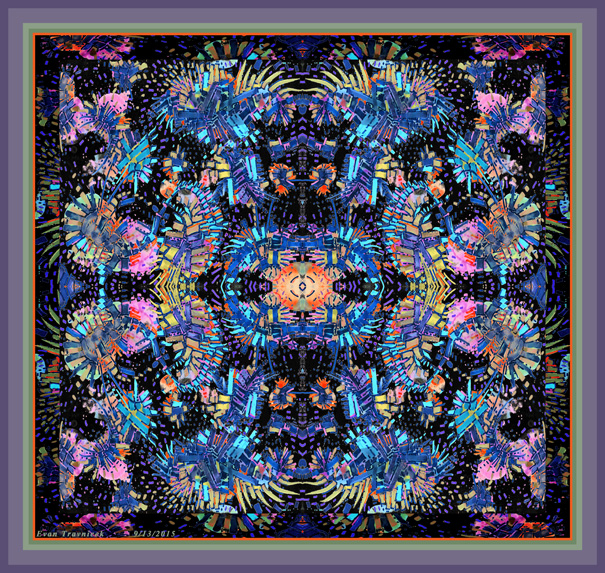
The original drawing for which this image is derived from was drawn back in June 2013. I posted a different version of this image in my blogs and profiles in November 2013. What’s different about this one is that I turned it clockwise ninety degrees. I also widened it so that it is more square, rather than rectangular. I did this because the previous version had these strokes on the extreme left and right of the picture that took too much attention away from the center. These strokes look like green blades of grass, or like iris shoots.
This piece has a centralized center of interest as a symmetrical composition. Therefore, I felt that the center should stand out to the viewer, rather than the edges. While it might be an interesting challenge to make a work of art that capitalizes on the extreme edges of its boundaries, that wasn’t the intent of this piece.
In countering the above noted conflicting trend, I emphasized the yellows near the center of the composition so as to draw the eye back into the center, where I want the eye to be drawn. I also deemphasized the bright greens filling the strokes on the sides. This piece was one of the most exciting versions I made of the original drawing I felt, but I just wasn’t happy about the composition.
I kept the title as The Feather Swept Sky for this version. For the blog of the previous version, I described how it’s symbolic of a spirit bird’s feathers sweeping a polluted sky. Due to recent learnings about the cyclical nature of our universe, our sun, and earth’s longer term climate cycles, I changed my mind about humans being the sole cause of the changes in our weather and climate. I suppose the turning of the image itself ninety degrees alludes to that change, if not a suggestion that earth’s poles might change drastically.
This piece also reminds me of a painting series I started when I was in high school. The first painting in that series is called The Universal Pond. The idea is supposed to play on cross cuts of planets, bodies of water, and bodies of land so that the viewer can see the depths of an ocean, and the sedimentary layers of some land like looking into an aquarium or terrarium. The Feather Swept Sky feels like it’s a variation along that series, if even only an abstract expression of it. Some of the strokes look like the leaves of grass or iris as I already mentioned.
 Art of eVan