
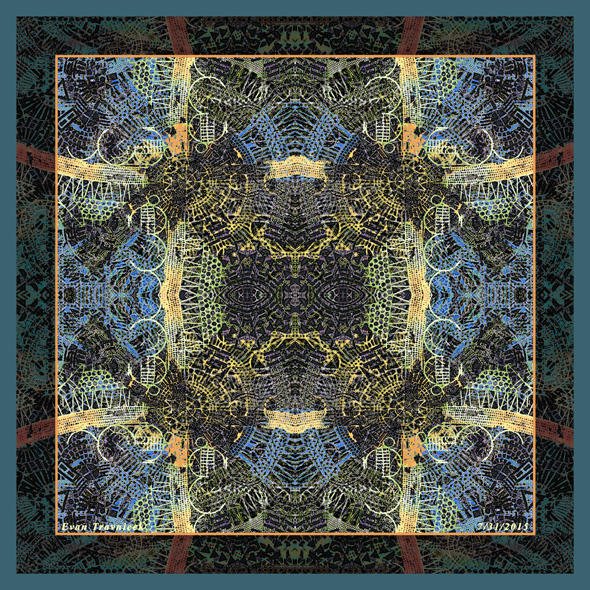
In a certain way, this image is like Pi squared squared. It should have a third and fourth dimension to it as well, but, alas! I can only produce various shades of light emitting from the flatscreen of your computer or handheld device in two dimensions. At least the frame surrounding the image gives you the illusion of depth as it recedes into darker shades.
I say Pi squared squared because the grid conjoining in the four equally proportionate sides—left, right, top, and bottom—look like Pi symbols on each side of the picture. If you don’t know what the Pi symbol looks like, then here it is: π. Now look at the image again, and see it in the orange and yellow grid formations. So there are four conjoined Pi symbols at right angles to one another.
I described to you in the last post the ancient Greek mathematician Archimedes’ Method of Exhaustion, and how polygons are used in increasing complexity to approximate Pi, as Pi is an irrational number that has an infinite amount of decimal places. There is indeed what looks like a semi-amorphous polygon (a square) in the center of the picture. The shape of it looks like it’s hinting at an eight pointed star as well. There’s that inchoate quality of pareidolia represented here again.
The materials I used to make this design were all derived from original hand drawn mosaics by myself. Primarily, it consists of two drawings—a new one called Without a Third Thought for which you have not seen yet, and another one I made a few years ago called Mandelic Mosaic. The combining of drawings and images from different sources by layering them creates new designs and more complexity. It’s the layering that creates the complexifying, shifting patterns that are so essential to bringing your mind to the edges of imagination.
Lately, I have noticed the trend in art of appropriation and collage making. I still don’t know what to make of all that; especially when more established artists take advantage of the pictures naive college students post on the internet and resell them as prints with only minuscular alterations. While I have used generic imagery from other sources on the internet for some of my art, I have also altered them enough so that they significantly differ from their original sources.
Having said that, I like to use my own material, and evolve it through successive designs and patterns. It’s like a process of framing a kaleidoscope at different points in its miasma of movement. Also, the layering of my own designs creates a sense of personal history through abstract imagery.
It looks like two mysterious and ancient ocular orifices are peering right at you in the center of this piece. It’s almost hypnotic, like you could sit and meditate in front of it and use it as a doorway for self-reflection. I hadn’t intended the effect of eyes, but within the process of situating the parts, pieces, and planes of the work, I synchronistically created them. I was pleased with that effect and honed in on it.
The title of this amalgamation is Drops of Rain and Shine in the Fabric of Time. It is one of my longer titles, but I felt it was appropriate as a poetic echo to give direction to your mind as to what it might represent. Of course you can have your own interpretations of what this work might mean to you. In fact, I encourage your imagination to take you wherever it leads while observing my art.
To me, it looks like drops of rain on the surface of a body of water; but it also looks cosmic, like the bridges, pathways, or fabric strands composing the yellow and orange grid are streams of light and coronal ejections. Astrophysicists describe time and space as a sort of fabric, so I imagined time and space as resembling water. The circular formations inculcating the blue background give the impression of rings from raindrops in puddles of water.
The four main circular formations, or wheels, can also be seen as four supermassive black holes, or quasars, on the edges of our known universe; their emissions are the orange streams, and they connect with one another, forming a grid that allows the physical universe to exist as a fractalized hologram. Almost like a Cartesian plane, but in a much more complicated matrix than a simple square graph.
 Art of eVan