Tag Archives: Amalgamation

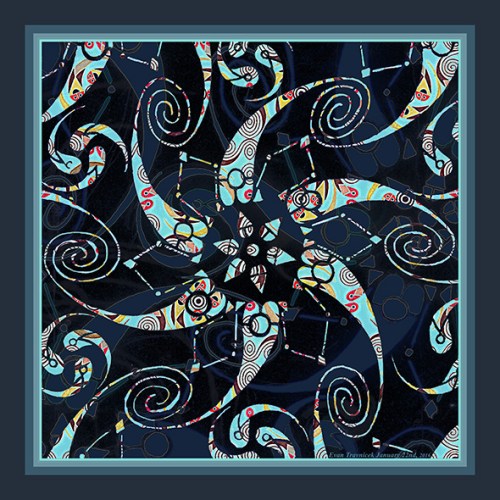
Your Stonewashed Dubba Dubba (v.1)

Since Instagram is continuing to insist on being a major ____sucker in suppressing me and my art page there, I’m going to post here again like I originally intended. Since Facebook took over Instagram, it has turned from the hottest social media into a basket case bottom dweller. Everyone I show this piece to loves it and says it should sell for thousands in a gallery. Too bad most art galleries are also vampiric ____suckers as well. Thanks for your support, those of you who aren’t fair weather flaky ghosts blown by the wafts of fake social media winds.

Leave a comment

February 11, 2020 · 7:23 am

The Heart of a Habit (version 5)

TheHeartOfAHabit5ematted

This digital illustration here is derived from two different drawings I executed on paper a couple of years ago. That was when I was fresh out of school having graduated with a degree in Health Information Technology. It was also after I had just attained my credential as a Registered Health Information Technician. I felt so proud of myself for accomplishing what I felt were these highlights of my life.

I titled this piece The Heart of a Habit. The two drawings I used in layering it together were Topology of Hearts, Hands, and Minds, and Happy Zephyrs. I created this digital amalgamation back in February, 2016. For some reason, I stopped making these mathematically approximated tessellations. You may see some influence of M.C. Escher’s work here. I started becoming more interested in liquid ambiences from applying water to water-based pen work, and rubbing alcohol to professional marker applications.

I’ve been trying to resolve a conflict for a long time with my art, and it keeps on morphing into my fascination with styles of art that are polarized. So, for example, Escher’s work is mathematically refined, and perspicuous, but Kandinsky’s work is the opposite, and, in some cases, is quite amorphic. I truly enjoy both styles of art: Optical illusion art, and abstract art. I’d like to make a bridge between Optical-type art, and purely Abstract art, which, to me, would be the ultimate optical-psychological form of art… at least at this point in time.

A habit is often unquestioned, and, like a heart, is hidden. One can only hear the beat of a heart if one listens closely. I make this comparison of a heart to a habit because, if one observes with curiosity, and without criticism, one often finds that a habit is used to fend off some unwanted circumstance or feeling. The word habit rhymes with the word rabbit, and rabbits run from danger. A rabbit’s heart races rapidly as it flees quickly from danger, such as a predator.

My art can be seen as a habit with which I use to escape the harsh realities of the world. I don’t think it needs to be pathologized however. I think it’s a constructive outlet for all the frustrations I’ve encountered in the medical and business fields. I’ve been making art since I was a baby, so it’s pointless to try to dismiss it as a neurosis. I am glad my art seems to defy George Orwell’s postulation that “all art is propaganda.” My art has become so abstract at this point that I feel it successfully escapes the orbit of politics. I just haven’t imagined a truly satirical, powerful, salient political art idea to illustrate for a few years now.


Specifications:

Title: The Heart of a Habit (version 2)

Source mediums: Water-based ink, on paper, manipulated digitally with filters

Print medium: Hewlett Packard printer ink from Hewlett Packard DesignJet Z2100 printer on Hewlett Packard print paper (Note: print can be made with archival paper and printer if requested)

Digital manipulation completed: 1/22/2016

Dimensions of print: 30 inches by 30 inches

Number of limited edition prints: 25

Contact me: artofevan@hotmail.com

Leave a comment

January 23, 2018 · 9:01 am

Hour Shed (version 4)

HourShed4ematted

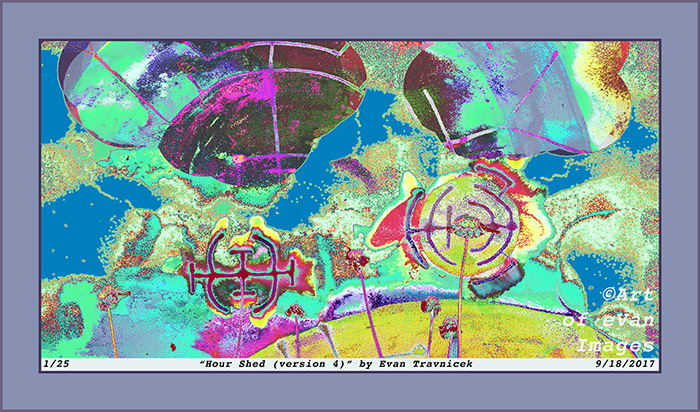
I call this one Hour Shed, as in shedding an hour of time. I think of it as an abstract, psychedelic landscape with a warped horizon. A couple of billowing clouds hover overhead, which are more like doorways to other dimensions. I just really have fun scanning drawings I make with mixed media. With the drawing I made for this piece, I used water-based ink pens (a Schneider pen), and alcohol based marker drawn on a small sketchpad. I then applied some water with an excellent flat head paint brush to make the water-based ink bleed. I let that dry, and then applied some ammonia as an experiment to see how the already applied media would interact with it. It didn’t really do much.

I then splashed some lacquer thinner over the surface of the drawing, which made the alcohol based marker bleed, and also the ink from the Schneider pen bled. After that dried, I applied some rubbing alcohol. The results left what I wanted: Discolored, blurred, cloudy, ambient, faded, psychedelic, bled effects.

I’d recently been listening to authors and documentaries discussing the hippie culture in Laurel Canyon during the 1960s. I already knew that the CIA covertly experimented with LSD on people unbeknownst to them. I also knew that the US government really wanted to find a way to divert anti-war protesters from attracting too much attention for being against the Vietnam war. So what I discovered is that the CIA helped to create the hippie counter-culture so as to discredit anti-war protesters and to divert young people into drugs, cheap sex, and other demoralizing activities.

I have always enjoyed abstract and psychedelic art. Much of my inspiration comes from the hippie counter-culture, including a lot of the music produced from that era. It’s just that I now see what purpose that scene served. Today, it’s plain to me that entertainers, artists, actors, and public figures get fame, attention and money because they agree to the CIA’s terms of spreading “American” cultural hegemony across the globe.

It has been known for years now that the American Abstract Expressionist movement was financed and nurtured by the CIA so that America could claim a culture of its own on the world stage. Centralized planners felt that America really had no art or culture up to that point when the Abstract Expressionists were forming, so the CIA decided to create a world stage for them. Again, I’m not repelled by the counter-culture movement of the Abstract Expressionists. I just note that they were allowed to become famous because they had secret state backing.

In my learning and research into art methods, techniques, psychological values, and history, I have come to conclude (perhaps for the time being) that art serves imperial purposes. It is used as propaganda. It entertains, amuses, impresses, catches attention, and thereby communicates messages consciously and unconsciously. An Italian Marxist named Antonio Gramsci called the proliferation of imperial culture, art, and propaganda cultural hegemony. This means that a dominant state—or superpower—superimposes its entertainment industry, such as Hollywood for example, on to subordinate states, thereby achieving a psychological penetration of the collective population.

Specifications:

Title: Hour Shed (version 4)

Source mediums: Water-based ink, alcohol-based marker altered by water, ammonia, lacquer thinner, and rubbing alcohol on paper, digitally combined with organic material

Print medium: Hewlett Packard printer ink from Hewlett Packard DesignJet Z2100 printer on Hewlett Packard print paper (Note: print can be made with archival paper and printer if requested)

Digital manipulation completed: 9/18/2017

Dimensions of print: 30 inches by 16 inches

Number of limited edition prints: 25

Investment of print not framed: $80

Investment of print framed with glass: $400.00 (shipping included)

Contact me: artofevan@hotmail.co

Leave a comment

September 18, 2017 · 9:20 am

Prayer of a Pillar (version 8)

PrayerOfAPillar8ematted

The idea here is a beautified, glorified, abstractified column. It became apparent to me as I was exploring other design configurations. This piece is derived from, believe it or not, Ataraxy (version 1). Of course I combined Ataraxy with a few layers of other material. Another example of that result is the piece I posted here back in August, 2015, called Galactic Template (version 2).

As far as common history is concerned, the architectural usage of columns dates back to ancient Egyptian times of around 3000 BCE. The ancient empire of Egypt is said to have originated in that time period. I only theorize that there could have been great civilizations, not alluded to in contemporary history books, that existed thousands, and perhaps tens of thousands, of years prior to ancient Egypt. Associate professor Robert M. Schoch has done considerable research revealing civilizations our current model of history ignores.

I chose to post this piece now because I had noticed my recent usage of the word “column” in my micro-blogging. My blogging is, of course, influenced heavily by what I notice going on in the world, and by other professional bloggers whose information and insights I value. I like to rely on my intuitive sense of informational flows; one way I do that is by noticing repeating patterns, including words, sounds, and images… even feelings. Perhaps especially feelings, as feelings are the place from which most people make decisions anyway.

A column can define a column in a newspaper, or it can define the architectural noun. To me, a column is a symbol of strength, civilization, calculation, order, governance, continuity, and stability. Perhaps this sense is intended to be communicated by journalists’ official use of columns.

At the bottom left and right of this picture are what appear to be stalks of grass, composed of black mosaic pieces. Or maybe they are skeletal impressions of hands beginning to cup and shroud the base of the column. Anyway, whether if the finger-tips of grass, or the phalanges of hands, they look like they are moving into a praying clasp. Hence, the title for this piece: Prayer of a Pillar.

The metaphorical, amorphic fingers merely suggest the form of hands as if each mosaic piece is obeying the non-physical commands of an unseen field moving them to pray. I’ve seen imaginary depictions of what it looked like in ancient Egyptian buildings and temples, and it appears that Egyptian artisans and their governing priesthoods liked to use bright, bold colors to fill in the shapes, forms, hieroglyphs, and figures engraved on their walls and pillars. So my idea of a column here has a more Eastern and ancient character to it, rather than a Western, colorless, marble quality.

This piece has a lot of detail in it—a quality I wanted to achieve—with an appealing sense of balance and order. As many other pieces of mine, this work looks like it could be a still of a kaleidoscope. I also like to imagine that you are looking through a microscope at an exotic, alien world other than what you might normally see as cells and microscopic debris. After all, one of my original pieces in the Micro-Chimerisms series is titled Microscopic Works of Light.

I may add that the black mosaic phalanges coming up into a prayer formation at the bottom of this illustration can also be seen as the petals of a lotus flower. The lotus flower is an Eastern symbol of enlightenment, as they blossom on the surfaces of muddy bodies of water; from the depths of darkness, illusion, suffering, and mud is born enlightenment. So I’m really combining the Western prayer, the column of strength, and an Eastern symbol of enlightenment here.

These layers of materials, collages, drawings, and texts, along with multiple multi-layered symbols creates an idea I want to communicate to you: That we are multi-dimensional beings who perceive multiple meanings in the vast perceptions we receive and emit everyday.

Leave a comment

May 2, 2016 · 1:13 am

Wrecked Tangles (After the Crash) H1

AfterTheCrashH1ematted

The archaic character you don’t recognize off to the lower right of this image is a character from the Glagolitic alphabet, which represents L in the English language. In my recent fascination with language and math characters from around the world, I have been drawing a few of them that catch my eye. Drawing a character from any alphabet puts its shape into my memory so I can redraw it anew in the future without having to look at it again for reference. In a sense, drawing, painting, and even writing helps me to commit anything to memory; it’s like a mapping process that helps to work out the kinks.

I drew several other letters, numbers, and punctuation marks from the English language to give you a sense of stability as a speaker of this language. While it is not my intention to alienate those of you who speak other languages, I must limit myself mostly to the usage of English when I draw a word in order to be able to explain what my intentions are for using that word in a particular art piece, as I am monolingual.

This image is basically the foundation drawing for Wrecked Tangles (After the Crash) H series. I find the letter H to identify the group it’s in to be quite fitting for it due to the fact that it looks like you are witnessing a three dimensionally imagined black-hole.

What it reminds me of is those explanations astrophysicists sometimes show to describe how a black-hole might look if it were three dimensional. They will place a heavy metal ball on to the surface of a bed, thereby depressing the part of the bed that the ball is placed on. These kinds of explanations of the curvature of space and time with respect to super-heavy objects–like black-holes–are, I feel, the best because they give a simple visual representation that anyone can understand.

I’ve been fascinated by surfaces, mediums, settings, contexts, and textures for a long time now. I’ve pretty much concluded that anything can be a tool or medium to use for artistic purposes. I wanted to reproduce a visualization I had of an information vortex, and express it in a Wrecked Tangles themed style. I have described to you before how you can imagine quilts being landscapes. Wrecked Tangles (After the Crash) H1 is another fulfillment for a variation on that theme.

I’m often amused by how the surface of beds can be used to explain the fabric of space and time, and their fabrics can also be used as surfaces to paint or draw on… that is, if they are prepared properly for that purpose. I find this all amusing because the bed is symbolic of sleep, dreaming, and pleasure. It is a doorway, if you will, for which your imagination can roam through its wildest dreams.

Leave a comment

Filed under Art of eVan

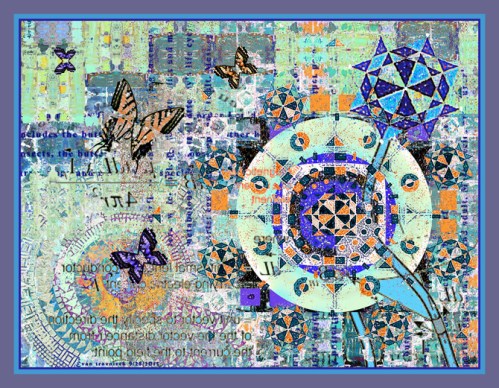
The Pastel Dust of Lepidoptera and Pollination (version 5)

The Pastel Dust of Lepidoptera and Pollination (version 5)

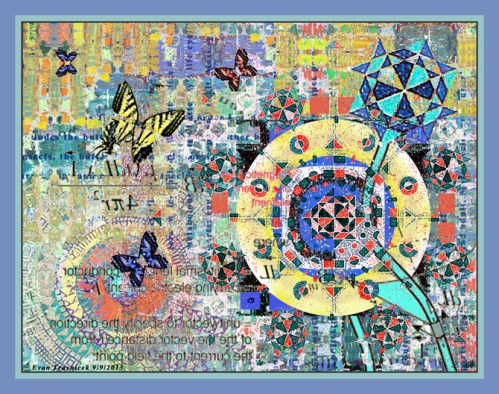
Version six of this image was posted back in September. In that post, I explained that it truly is a hybridized mixed media project. Bits and pieces of creation, whether if by the hand of nature, or by the hand of eVan, were gathered together and integrated on to an electronic canvas.

One thing that I didn’t describe to you, however, is that bulb-like flower with a blue stem on the right side of the picture. It’s actually from a diagram depicting the Bio-Savart law. This law is basically an equation describing the magnetic field generated by an electric current. An electric current, its proximity, length, direction and magnitude are related to a magnetic field in the equation used to compute the Bio-Savart law.

Explaining math to you wasn’t the intent of this project however. Even the title of this series is quite long and requires some attention. I thought of shortening the title to Pastel Dust of Lepidoptera, but I already posted a previous version (version 6) with the long title, so I decided to roll with what I originally started with in the title.

Dust can be found on butterflies, moths, and on the ends of stamens of flowers, and the colors of these naturally occurring dust-like substances are often a pleasurable sight to witness. Colorfully compacted dust is also used in oil pastels for artists to create art works.

I used a piece from my Wrecked Tangles (Encircled) series for the background of this work, which involved the usage of oil pastels. Dust is symbolic of time, as in the sand that is used in hour glasses, or, the sand that resides on beaches which seem to continue on forever into the horizon.

Dust is also symbolic of taking many small steps in order to complete a project. When you finally complete a detailed and lengthy project, you can relax at the end of your constructed beach and enjoy the beach-scape built by your own efforts.

Leave a comment

December 28, 2013 · 4:06 am

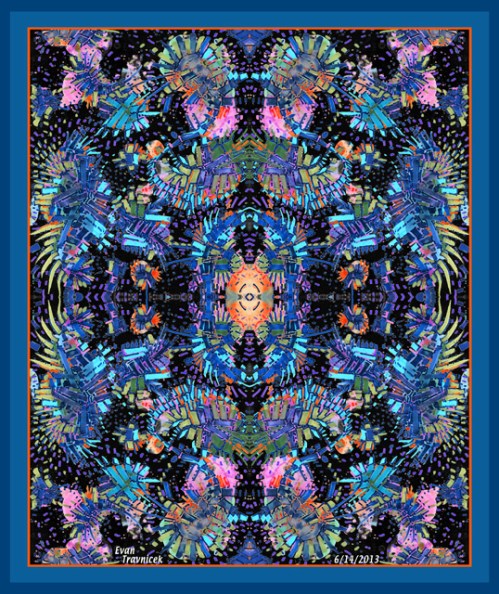
The Feather-Swept Sky (version 5)

The Feather-Swept Sky (version 5)

I made this image back in June, 2013. It started out with using magic marker on paper. There was some bleed through from some rubbing alcohol I applied to drawings on previous pages. I incorporated the designs into the stains.

What you see here is a digital manipulation of the original drawing. It’s basically the drawing times four. I use mirroring techniques to accomplish what you see here, as well as in other images.

I realized that the process that I take in many of my creations is the process of unfoldment. Unfoldment is different than development in the sense that unfolding is organic, and flower like, whereas development is more machine like, and each machine developed can’t develop more without a designer making a new model.

Unfoldment is a process that takes place from within a living organism or being. So growth, life, and will come from within a living being, not a “lifeless” machine.

I titled this piece The Feather Swept Sky. I imagined all the feathers of birds sweeping the skies of earth and magically sweeping away all the pollution. This image reminds me of some Native American art and jewelry. It also reminds me of ancient Egyptian art work and jewelry.

I suppose it’s a religious and mystical image bringing us all back a reminder of ancient religions, tribes, and civilizations. It’s the wisdom from our past, and the magical beliefs people had. Especially the belief of respecting and honoring the earth as a living, breathing being, not a dead rock to be used up by the never-ending greed of one percent moguls.

1 Comment

November 21, 2013 · 4:38 am

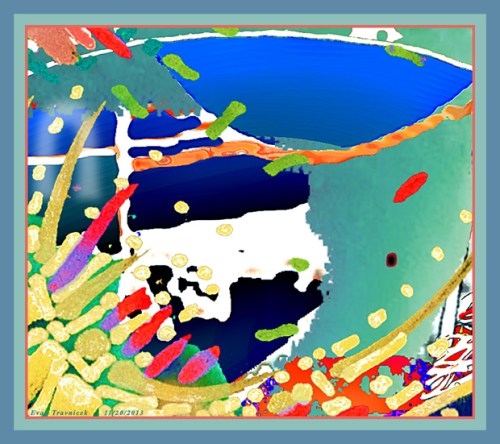
Yellow Tide (version 1)

Yellow Tide (version 1)

It looks like a lot of people liked Purple Tide, the last image I uploaded here last night. Well, this is Yellow Tide. It’s actually the predecessor to Purple Tide. It’s the same design, but the colors are inverted.

To be sure, this is part of a drawing I created with mixed media on paper, including magic marker and rubbing alcohol. Thinking of rubbing alcohol gives one a cool feeling, as this is how it feels when you rub it on your skin.

I used to live in southern California, and would visit the beaches there on the West coast every once in a while. The colors in Yellow tide remind me some of the memories I have of going to New Port, Dana Point, San Clemente, or Laguna.

Yet, this image is abstract enough to merely suggest a beach scene. In fact, if you get a totally different impression, then, by all means, let yourself explore that line of thought into your own imagination, and use this image as a doorway to help you get there.

Leave a comment

November 21, 2013 · 4:32 am

Purple Tide (version 1)

Purple Tide (version 1)

This image here is a fragment chosen from Ploidy the Diploid, which is another image in this album. As I often do when I get a chance, I pull out previous works I’ve done and see new things in them that intuitively look like they could be independent art works in themselves.

Creation has a tendency to morph and grow out of what came before, even when it seems completely unrelated. The subconscious mind is a lot less discriminative, and categorical in the sense of conscious classification systems. In fact, chief editors of newspapers and magazines know that the positioning of supposedly unrelated ads actually contribute to an article you may be reading. It actually gets digested in your subconscious mind as one interrelated kilobyte of information.

So this image here looks to me like an ocean wave under a purple and red sky. My fascination with alien planets makes me think of an ocean somewhere else in the universe. Though it is independent of earth, the properties of this imaginary place are connected and related in the sense of liquid, and high & low tides.

It’s just a very liquid picture composed of relatively basic abstract shapes, another one of my approaches to creation. That’s the thing, I really like to embroil my audience with intricacies and complexities in my art, but I try to point out the basic and simple shapes that are used to construct such elaborate labyrinths.

It’s the idea of perfection versus imperfection, and all of the intuitive visual equations that I subconsciously work out in the water of my mind.

1 Comment

November 20, 2013 · 7:37 am

Pastel Dust of Pollen and Lepidoptera (version 6)

Pastel Dust of Pollen and Lepidoptera (version 6)

Digital material from one of my original oil paintings, some of my mixed media pastel drawings, ball-point pen drawings, and some real butterfly wings went into the creation of this piece.

I used some of the scanned material from my Wrecked Tangles (Encircled) A series project as the background. Also, the design from Industrial Mandala was used. Again, Industrial Mandala is a digital manipulation from my original oil painting: Of Which I Am a Part.

I incorporated some text on Wikipedia’s definition of a butterfly in the background. You can make out a little bit of it, but my intention was to add some filler to the background design, and I thought a scientific description of the butterfly was fitting. Lepidoptera is the Latin term for butterfly.

The butterfly wings were actually some remains of a butterfly that one of our cats dragged in after stalking it in our backyard garden. For some reason, I hung on to the wings and put them up on a shelf. Later on, I had this idea that I should scan the wings on to the computer so as to use them for a future project.

Well, here is that future project. I’ve been wanting to explore some more of my ideas using the mandala design format. This is another result of that. I feel that I’m getting a better feel of what I want to master. Eventually, I want to start experimenting with using diagrams and drawings of parts of plants, animals, people, and machines. This image I’m sharing with you here is where I’m at for now however.

1 Comment

September 9, 2013 · 7:50 am